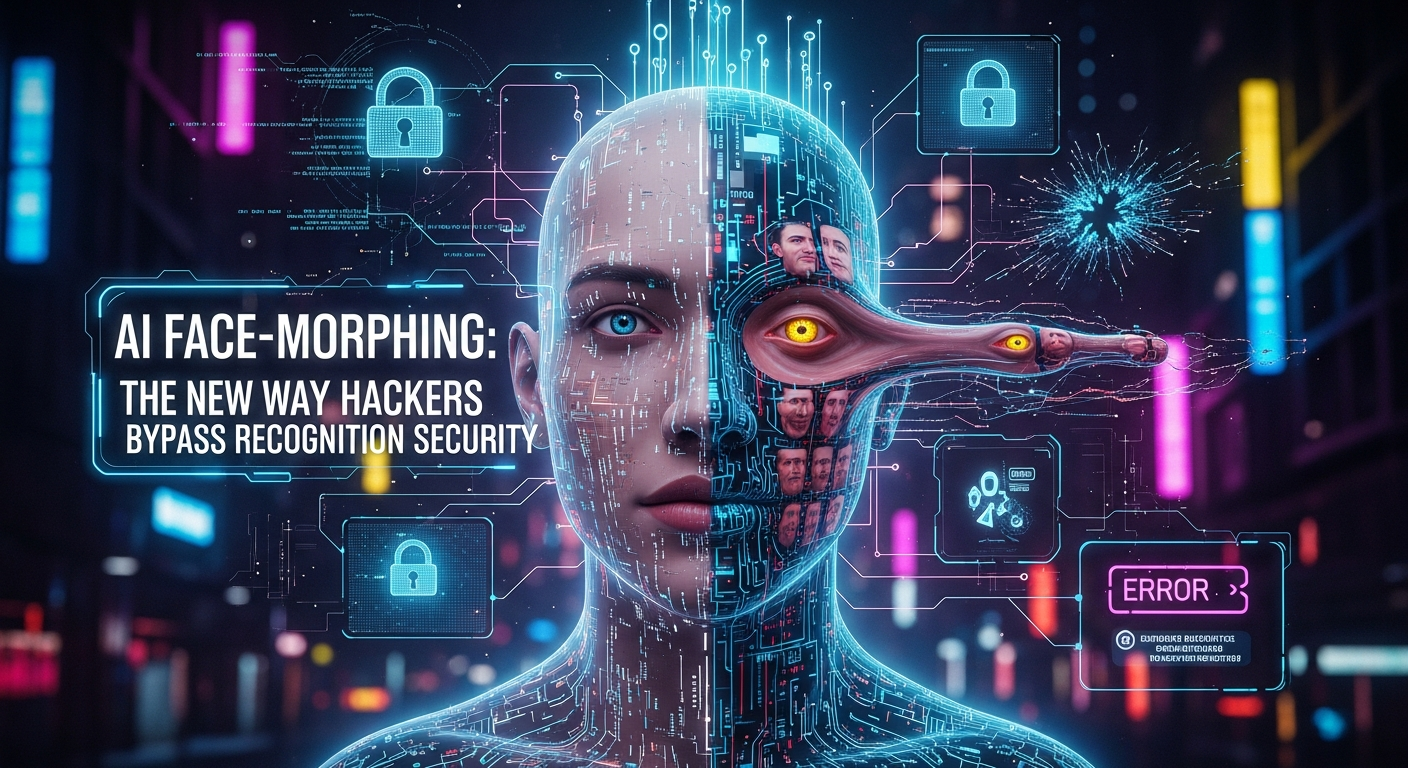
AI Face-Morphing: The New Way Hackers Bypass Facial Recognition Security
Quick Answer (TL;DR)
- AI face-morphing uses deep learning, particularly Generative Adversarial Networks (GANs), to blend multiple facial identities into a single, hyper-realistic synthetic image designed to fool biometric authentication systems.
- The primary attack vector targets the enrollment stage of security systems, such as passport applications or corporate access control, allowing a morphed photo to act as a biometric "master key" for multiple individuals.
- Effective countermeasures involve a multi-layered defense, combining advanced Morphing Attack Detection (MAD) algorithms, robust biometric liveness detection to verify a real person is present, and stricter, supervised enrollment procedures.
Introduction
In the silent, sterile corridors of a high-tech data center or the bustling, anonymous flow of an international airport, facial recognition stands as the invisible guardian. It is the gatekeeper of our modern world, a seamless and sophisticated lock that uses the one key we believe to be unique: our own face. We use it to unlock our smartphones, access our bank accounts, and cross borders with unprecedented ease. This technology has been hailed as the pinnacle of personal security, a biological password that cannot be forgotten, stolen, or shared. But this fortress of biometric certainty has a ghost at its gates, a digital doppelgänger crafted by the very artificial intelligence that was supposed to make us safer. This threat is not a physical mask or a clever disguise; it is a silent, insidious infiltration known as AI face-morphing.
Imagine a single passport photograph that holds the biometric data of two different people. To the human eye, it looks like a plausible, if unremarkable, individual. To a facial recognition algorithm, however, this single image is a paradox—it is both people at once. This is the core of a morphing attack: the creation of a synthetic, high-fidelity Trojan horse. An attacker can create a composite image that blends their face with that of a target, submit it during an identity verification or enrollment process, and create a credential that both individuals can use. The system's trust is compromised at its very foundation. This article delves into the dark artistry of AI face-morphing, dissecting the technology that powers it, the devastating ways it is exploited to breach our most secure systems, and the urgent, escalating arms race to develop countermeasures that can distinguish a true face from a masterfully crafted lie.
The Digital Doppelgänger: Understanding the Mechanics of AI Face-Morphing
At the heart of AI-driven face-morphing lies a sophisticated and powerful technology known as Generative Adversarial Networks, or GANs. To understand how a morphed face is created, one must first appreciate the elegant, competitive dance of the GAN architecture. A GAN consists of two dueling neural networks: the Generator and the Discriminator. The Generator's job is to create synthetic data—in this case, facial images. The Discriminator's job is to act as a discerning critic, trained on a vast dataset of real faces, whose sole purpose is to distinguish between the Generator's forgeries and authentic images. They are locked in a relentless cycle of improvement. The Generator creates an image, the Discriminator calls it a fake, and provides feedback. The Generator adjusts its process and tries again, getting progressively better with each iteration until its creations are so convincing that the Discriminator can no longer reliably tell the difference. This adversarial process is what allows GANs to produce the hyper-realistic, high-resolution faces that are the bedrock of a morphing attack.
The process of creating a morphed identity is a methodical, multi-step operation. It begins with Image Acquisition, where an attacker gathers high-quality photographs of two or more individuals—the accomplice (who will use the credential) and the target(s). These are often scraped from social media profiles or other online sources. Next, the algorithm performs Facial Landmark Detection, using computer vision libraries to pinpoint dozens of key points on each face, such as the corners of the eyes, the tip of the nose, the jawline, and the shape of the mouth. These landmarks serve as a digital skeleton for the faces. The subsequent step involves Alignment and Warping, where the software geometrically manipulates the faces, rotating and scaling them so that their key landmarks overlap perfectly. This ensures that the foundational structures are in sync before the blending process begins.
The final, crucial stage is the Blending and Generation powered by the GAN. Unlike a simple Photoshop blend that just averages pixel colors, the GAN's Generator intelligently synthesizes an entirely new face. It doesn't just mix textures; it combines the underlying biometric features. It might take the eye shape from one person and the jaw structure from another, creating a novel but coherent biometric template. The goal is not just to create an image that looks plausible to a human, but one that contains enough unique biometric information from both original faces to satisfy a facial recognition algorithm. In technical terms, every face can be represented as a "feature vector"—a mathematical summary of its key characteristics. A successful morphed image generates a feature vector that resides in the "face space" somewhere between the vectors of the original individuals, making it close enough to both to trigger a positive match. This creates a biometric master key, a single image that unlocks access for multiple, distinct identities.
The Trojan Face: How Morphing Attacks Infiltrate Security Systems
The genius and danger of a face-morphing attack lie not in its ability to fool a system in real-time with a live video feed, but in its strategic targeting of the system's most vulnerable moment: the enrollment phase. This is the point where the system establishes its ground truth, creating the trusted template against which all future authentication attempts will be measured. By poisoning this initial well of data, attackers corrupt the entire security chain from the outset. Once a morphed image is accepted and enrolled, the system considers it a legitimate identity, making subsequent bypasses trivial. The attack vector manifests in several critical, high-stakes scenarios where identity verification is paramount. The most widely studied and feared application is in the realm of border control and travel documents.
Consider the process of applying for an e-passport. In many countries, applicants can submit their own digital photograph online. An attacker, working with an accomplice, can use GANs to create a morphed image blending the accomplice's face with the face of a person on a watchlist or someone who is otherwise ineligible for travel. The accomplice, who has a clean record, submits this morphed photo with their application. The passport is issued in the accomplice's name but contains a biometric chip encoded with the morphed face. At an automated border control e-gate, either the accomplice or the target individual can now use the passport. The e-gate's camera captures the live face of the traveler and compares its biometric data to the template on the passport chip. Since the template contains sufficient biometric features of both individuals, the system will very likely register a match, and the gate will swing open. This fundamentally breaks the core principle of one person, one passport, creating a legitimate government-issued document that can be used by multiple people.
Humanize your text and bypass any AI detector instantly with Undetectable AI.
BYPASS AI DETECTION NOWThis same principle extends to the corporate world and the financial sector. In a corporate security context, a disgruntled employee could collude with an outsider to gain access to a secure facility. They could generate a morphed image to enroll in a new biometric access control system. Once enrolled, the system's card readers or scanners would grant access to both the authorized employee and the unauthorized infiltrator, creating a massive vulnerability for corporate espionage, data theft, or physical sabotage. In the financial industry, the rise of digital onboarding and Know Your Customer (KYC) regulations has led to widespread use of facial recognition for remote identity verification. An attacker could use a morphed photo on a fake or stolen ID to open a bank account. This "synthetic identity" could then be used by a network of criminals to launder money, apply for fraudulent loans, or perform other illegal activities, making it incredibly difficult for law enforcement to trace the true identity of the individuals operating the account.
The Silent Threat: Real-World Implications and High-Stakes Risks
The consequences of successful face-morphing attacks extend far beyond the technical failure of a security system; they strike at the foundational trust of our societal and economic structures. The most immediate and alarming implications are in the domain of national security. The ability to subvert automated border controls, which are being increasingly deployed globally to manage high volumes of travelers, represents a catastrophic vulnerability. A single successful morphing attack could allow a known terrorist, a foreign intelligence agent, or a member of a transnational criminal organization to enter a country undetected, using a valid passport that biometrically matches their face. This doesn't just undermine the multi-billion-dollar investment in border security technology; it erodes the very concept of a secure border and jeopardizes public safety on a massive scale. The threat is not hypothetical; research by institutions like the University of Notre Dame has demonstrated that current-generation facial recognition systems, including those used by governments, are highly susceptible to these attacks.
In the corporate sphere, the risks translate to severe economic and intellectual property losses. Imagine a competitor gaining physical access to a company's most sensitive research and development lab or a data center housing proprietary source code and customer data. A morphing attack facilitates this by creating a legitimate-looking "ghost" identity within the system. The access logs would show an authorized employee entering the facility, while in reality, an industrial spy is walking the halls. The damage from such a breach could be immeasurable, leading to the loss of competitive advantage, costly litigation, and irreparable reputational harm. The stealthy nature of the attack means the breach might not be discovered for months, if at all, making it nearly impossible to quantify the full extent of the damage or identify the perpetrator.
Beyond security and espionage, face-morphing poses a profound threat to the integrity of our financial systems. The ability to create synthetic identities that can pass KYC checks opens the door to large-scale, sophisticated financial fraud. Criminal syndicates could create vast networks of bank accounts controlled by multiple operators using a single set of morphed credentials, making it easier to launder money and harder for anti-fraud systems to detect suspicious patterns. This also creates a legal and accountability nightmare. If a crime is committed using a morphed identity, who is legally responsible? Is it the person who submitted the application, or the person whose face was unknowingly scraped from social media and blended into the image? This ambiguity makes prosecution incredibly difficult and could lead to innocent individuals being implicated in crimes they had no knowledge of, simply because their biometric data was hijacked and weaponized.
Fortifying the Gates: Solutions and Countermeasures Against Morphing Attacks
The fight against AI face-morphing is a critical frontier in cybersecurity, demanding a sophisticated, multi-layered defense strategy. Relying on a single point of failure is no longer an option. The primary technological defense is known as Morphing Attack Detection (MAD). MAD solutions are algorithms specifically designed to analyze an image and determine if it is a synthetic composite of multiple identities. These solutions are broadly categorized into two types. The first is Single-Image (No-Reference) MAD. This method is employed during the enrollment phase, analyzing the single photograph submitted by an applicant. These algorithms act as digital forensic experts, searching for subtle artifacts and inconsistencies that are often invisible to the human eye but are tell-tale signs of GAN-based generation. They analyze image compression patterns, noise distribution, pixel inconsistencies between different facial regions (e.g., the eyes versus the chin), and unnatural textures that deviate from those of a genuine photograph. The goal is to flag a suspicious image before it can ever become a trusted template in the system.
The second category is Differential (Reference-Based) MAD. This... and implement these strategies to ensure long-term success.
Conclusion
In summary, staying ahead of these trends is the key to business longevity and security. By following this guide, you maximize your growth and ensure a stable digital future.
Don't wait for the headlines. Our Private Telegram Channel delivers real-time AI security updates and digital wealth strategies before they go viral. Stay protected. Stay ahead.
⚡ JOIN THE 1% NOW🧰 Try Our Free Tools & Calculators
No sign-up required. Instantly check risks, analyze AI text, or calculate your digital finances.