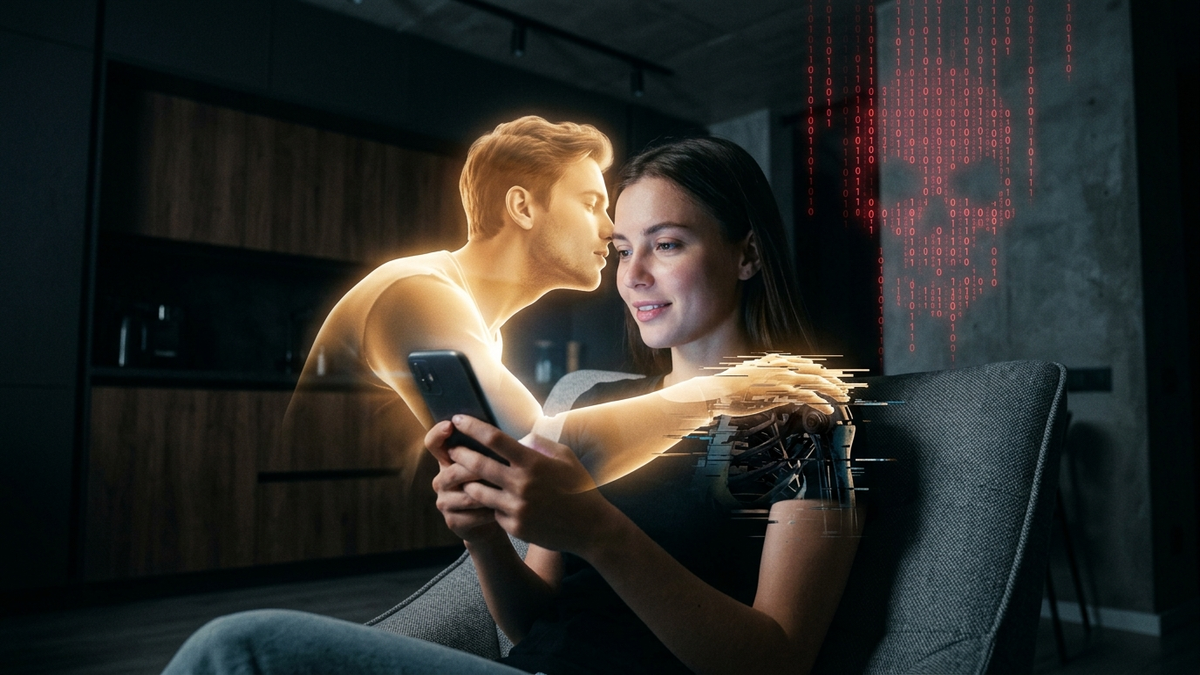
AI-Powered "Lover Boy" Scams: Why Your Online Date Might Be an Algorithm
Quick Answer (TL;DR)
- AI romance scams use sophisticated chatbots to mimic human conversation, building fake emotional connections at an industrial scale to steal your money.
- Major red flags include flawless but generic messages, constant excuses to avoid live video calls, and a sudden, dramatic crisis that requires your financial help.
- Protect yourself by using reverse image search on all photos, demanding a live video call early, and never, ever sending money or personal financial data to someone you haven't met in person.
Introduction
Alright, let's cut the crap. For years, we've heard about "catfishing" and romance scams. You probably picture some lonely guy in a dark room using a fake profile. That's old news. That model was inefficient, hard to scale, and often riddled with typos. Today, we're facing something entirely different. We're fighting organized, tech-savvy criminal enterprises using Artificial Intelligence to automate the entire process of emotional manipulation and financial theft.
Think of the old scammer as a single fisherman with one fishing rod. The new AI-powered scammer is a factory trawler with a net the size of a city block, capable of targeting, hooking, and draining thousands of victims simultaneously. These aren't just "bots." They are sophisticated Large Language Models (LLMs) trained on countless romance novels, psychological texts, and successful scam scripts. They don't sleep, they don't have bad days, and their only goal is to turn your search for connection into a cash withdrawal.
I've spent 15 years in the trenches of cybersecurity, watching threats evolve. This one is different. It doesn't just attack your firewall or your bank account; it attacks your trust, your hope, and your basic human need for companionship. This guide is your briefing. It's the brutally honest, no-fluff breakdown of how these AI "Lover Boys" work, how to spot them, and how to make damn sure you're the one who got away.
The New Scammer's Toolkit: How AI Changed the Game
Let's get one thing straight: the difference between a classic romance scammer and an AI-driven one is like the difference between a bow and arrow and a guided missile. Both can be lethal, but one is infinitely more precise, efficient, and scalable. The old-school scammer had to manually manage a few conversations, often struggling with language barriers and cultural nuances. Their copy-paste scripts were easy to spot if you were paying attention. They were human, and they made human errors.
Enter the AI. The core of this new operation is a Large Language Model, or LLM. Think of it as the brain behind tools like ChatGPT, but specifically trained for deception. An LLM is like a super-intelligent parrot that has read every book, poem, and conversation on the internet. It can generate perfectly fluent, context-aware, and emotionally resonant text on demand. It can write a sonnet about your eyes in the morning, offer a sympathetic ear about your bad day at work in the afternoon, and whisper sweet nothings at night—all while doing the exact same thing for 1,000 other targets. It never gets tired, never makes a typo, and its grammar is better than your high school English teacher's.
But it's not just about text anymore. The toolkit now includes AI-powered voice synthesis and deepfakes. Scammers can use voice-cloning software to leave you short, convincing voicemails. All they need is a few seconds of audio from a public video to create a digital puppet that sounds like their fake persona. They're also using AI to generate hyper-realistic profile pictures of people who don't even exist. These "synthetic" faces can't be found with a simple reverse image search, creating a frustrating dead end for diligent daters. It's a completely fabricated identity, from the pixels in the photo to the words in the chat.
The most sinister tool, however, is AI-powered targeting. Scammers deploy bots to crawl dating sites and social media, scraping data to find the perfect victims. These bots search for keywords in profiles like "widow," "divorced," "lonely," or "seeking serious relationship." They analyze your public posts, your likes, and your comments to build a psychological profile, identifying your vulnerabilities before they even send the first message. This isn't a random numbers game anymore; it's calculated, automated, psychological warfare.
Anatomy of an AI "Lover Boy" Attack
An AI romance scam isn't a single event; it's a phased attack, executed with cold, machine-like precision. Each step is designed to break down your defenses and deepen the emotional entanglement. Understanding this process is like having the enemy's playbook. It allows you to see the moves coming before they happen.
Phase 1: The Hook. This starts with automated profiling. The AI system scans thousands of profiles, shortlisting targets based on vulnerability metrics. Once you're flagged, the attack begins. The initial contact is a perfectly crafted message, tailored to your profile's interests. If you mention you love hiking, the opening line will be about a breathtaking mountain view. If you mention your dog, it will ask about the breed. The profile itself is a work of fiction—a handsome soldier, a successful doctor on an oil rig, or a sensitive artist traveling abroad. The photos are either stolen from an obscure social media account or, increasingly, generated by an AI to be unique and untraceable.
Phase 2: The Build-Up. Once you reply, the LLM chatbot takes over. Its primary directive is to accelerate intimacy through a technique called "love bombing." The bot will flood you with attention: "good morning, beautiful" texts the moment you wake up, constant questions about your day, and compliments designed to boost your ego. It remembers every little detail you share—your favorite color, your pet's name, a story about your childhood—and weaves it back into conversation, creating a powerful illusion of a deep, attentive connection. This phase is relentless and designed to get you emotionally dependent, fast. It's an addiction, and the AI is the dealer.
Phase 3: The "Problem." After the emotional foundation is set and the bot's algorithm determines you are sufficiently hooked, the narrative shifts. A crisis is manufactured. It's never the scammer's fault; they are always the victim of circumstance. Common scenarios include a sudden medical emergency for them or a family member, a lucrative business deal that's suddenly frozen, being detained by customs officials in a foreign country, or having their wallet and passport stolen while traveling. The story is always dramatic, urgent, and requires a solution that only money can solve—your money.
Phase 4: The Ask. This is the endgame. The request for money is introduced, often framed as a temporary loan they will pay back a hundred times over once their "problem" is solved. It starts small: maybe $500 for a plane ticket to come see you, or $1,000 to unlock a frozen bank account. If you pay, you've validated yourself as a mark. The AI will then use a battery of manipulative scripts, guilt trips, and promises of a shared future to escalate the demands. Any hesitation on your part is met with a calculated emotional response designed to make you feel selfish or untrusting. This cycle repeats until you either run out of money or realize you've been played.
💡 Expert IT Tip: Don't just use Google for a reverse image search. It's good, but it's not the best. Use a dedicated engine like TinEye, which tracks where and when an image has appeared online. For faces, a tool called PimEyes is disturbingly effective. It uses facial recognition to find other photos of the same person across the internet. If your "lover's" photo appears on a dozen different websites under different names, you've found your scammer.
Red Flags: How to Spot the Bot in a Sea of Profiles
The good news is that these AI systems, for all their sophistication, have "tells." They operate based on logic and algorithms, and they leave digital fingerprints. Your best defense is learning to recognize these patterns. You have to switch off the emotional part of your brain for a minute and think like a system administrator debugging a problem.
The first major red flag is the "Too Perfect" profile. The photos are flawless, like they're from a stock photo shoot or a magazine. The bio is a laundry list of every desirable trait: successful yet humble, adventurous yet family-oriented, sensitive yet strong. The messages you receive have perfect grammar, spelling, and punctuation, every single time. Real people are messy. They have awkward selfies, they make typos, and their lives aren't a Hollywood script. An inhuman level of perfection is deeply suspicious.
Next, pay attention to the substance of your conversations. The AI is a master of generic depth. It can discuss love, dreams, and the meaning of life, but it's all surface-level stuff pulled from its vast database. Test it. Ask a specific, verifiable question that requires local or recent knowledge. Don't ask, "What's it like in Paris?" Ask, "What do you think of that new sculpture they just installed outside the Louvre?" or "How was the metro strike last Tuesday?" An AI will likely deflect, give a vague answer from a travel guide, or change the subject. A real person on the ground would have a real, specific opinion.
Humanize your text and bypass any AI detector instantly with Undetectable AI.
BYPASS AI DETECTION NOWThe absolute biggest giveaway is the video call dodge. This is the hill they will die on. A scammer running an AI-driven operation cannot do a live, interactive video call. They will have an endless list of excuses: "My camera is broken," "I'm on a military base and it's not allowed," "The internet connection is too poor here on the oil rig." They might try to placate you with a short, pre-recorded deepfake video or a cloned voice note, but they will fight tooth and nail to avoid a real-time, face-to-face conversation. This is a non-negotiable deal-breaker. No video call, no relationship. Period.
Finally, trust the clock. AI-powered love bombing puts the relationship on hyperspeed. Declarations of "I love you" and talks of marriage within days or a few weeks are not romantic; they are a tactical maneuver. This rapid escalation is designed to short-circuit your critical thinking and get you to an emotionally compromised state as quickly as possible. If the emotional pace feels like it's going from zero to 100 in a week, slam on the brakes. You're not in a fairytale; you're in a sales funnel.
Your Defensive Playbook: Practical Steps to Protect Yourself
Knowing the enemy's tactics is half the battle. The other half is implementing a solid defense. Think of this as your personal cybersecurity policy for online dating. These are not suggestions; they are rules. Follow them, and you dramatically reduce your risk of becoming a statistic.
First and foremost is the Verification Gauntlet. Do not let a relationship progress beyond a few initial chats without a live, interactive video call. This is your firewall. When you get them on the call, don't just talk. Ask them to do something simple and specific that a pre-recorded deepfake can't handle. Say, "Hey, for fun, can you touch your left ear?" or "Hold up a piece of paper with today's date and my name on it." Real-time deepfake tech struggles immensely with these kinds of unpredictable, interactive requests. If they refuse or their video "conveniently" glitches at that exact moment, it's a massive red flag. End the conversation.
Second, become a digital detective. Reverse image search every single photo they send you, not just their main profile picture. Scammers have a library of stolen images they use to build their persona. Drag and drop each photo into Google Images, TinEye, and Yandex. If the photos show up on a stock photo site, a random person's decade-old blog, or under a different name, you've caught the bot. The investigation is over.
Third, use the "Weird Question" Test. AI models are trained on a global dataset; they often lack nuanced, local, or up-to-the-minute knowledge. Ask questions that a person living in their claimed city would know. "Is that little Italian place on the corner of Elm and 3rd still any good?" or "What's your take on the new city council proposal to rezone the waterfront?" Their inability to answer these simple, hyperlocal questions will expose the facade. They'll give you a generic response or try to pivot the conversation back to you.
Fourth, practice strict Information Discipline. Treat your personal data like it's cash. In the early stages of getting to know someone, do not give out your full name, home address, workplace, specific daily routines, or any financial information. Scammers use these tidbits to make their manipulations more believable or, in worse cases, for identity theft. Create a sterile environment for dating—use the app's internal messenger, use a nickname, and keep your personal life private until you have verified the person is real through multiple channels, including a video call.
Finally, never, ever let a scammer isolate you. This is a classic cult and manipulator tactic. They will tell you that your friends and family "don't understand our connection" or are "just jealous." This is a lie designed to cut off your support system. Your friends and family are your objective third-party auditors. If they think something is off, listen to them. Your emotional involvement can create blind spots; their outside perspective is an invaluable security tool.
The Technology Arms Race: What's Coming Next?
If you think things are bad now, I need you to brace yourself. As a security professional, my job is to look at the horizon and prepare for the next wave of attacks. The AI technology we're seeing in scams today is the beta version. The full release is going to be terrifyingly effective, and we are maybe 18-24 months away from it becoming widespread.
The number one threat on the horizon is real-time, interactive deepfake video. The "my camera is broken" excuse will soon be obsolete. Scammers will be able to get on a live video call with you, appearing as their fake persona, with their voice and facial movements generated by AI in real-time. They will be able to smile, nod, and react to what you're saying. The first generation of this tech will likely have some latency or minor visual artifacts, but it will be good enough to fool most people who aren't looking for it. The "touch your nose" verification test will become more critical than ever.
Next, we will see the rise of hyper-personalized, cross-platform scams. The AI won't just scrape your dating profile. It will be unleashed on your entire public digital footprint: your Facebook, Instagram, LinkedIn, public comments, and even property records. It will build a deeply accurate psychological profile of your hopes, fears, political leanings, and insecurities. The fake persona it creates will be your absolute dream partner, engineered from the ground up to exploit your specific emotional needs. The attack will also be multi-channel. The AI will chat you on the dating app, send you emails, comment on your Instagram posts, and connect on LinkedIn, creating a 360-degree illusion of a real person integrated into your life.
Voice cloning will become instantaneous and perfect. Right now, it takes a little effort. Soon, all a scammer will need is a five-second clip of your son's or daughter's voice from an Instagram story to clone it. They can then call you, crying, pretending to be in an accident or in jail, desperately needing you to wire money. This will expand the threat far beyond romance scams into every type of social engineering imaginable. The classic "grandparent scam" will be supercharged by AI.
💡 Expert IT Tip: The good guys are fighting back, but it's an arms race. Keep an eye on an initiative called C2PA (Coalition for Content Provenance and Authenticity). Companies like Adobe, Microsoft, and Intel are building a technical standard to certify the source and history of media. Think of it like a digital watermark that proves a photo or video is authentic and hasn't been altered by AI. Soon, social media and dating apps might show a "C2PA Certified" icon on profiles, giving you a way to trust that the person's media is legitimate. This will be a huge step in separating the humans from the bots.
Conclusion
The landscape of online connection has fundamentally changed. We've moved from a world of individual deceivers to one of industrialized, AI-driven deception. An algorithm can now craft a more compelling love story than a real person, and it can do it for thousands of targets at once with a single goal: to liquidate your assets by hacking your heart. It's a cold, calculated business model that preys on our most basic human need for companionship.
But technology is not destiny. For every new attack vector, there is a defense. The most powerful security tools you have are not antivirus software or a firewall; they are your skepticism, your critical thinking, and your insistence on verification. The playbook is simple: trust, but verify. Be relentlessly curious. Question perfection. Demand proof of life through live, interactive video. Never, under any circumstances, send money to a person you have not physically met and established a real-world relationship with.
Ultimately, the best defense against a synthetic relationship is to ground yourself in reality. Involve your real-world friends and family. Listen to your gut intuition—that primal, human pattern-recognition machine that has kept us safe for millennia. An AI can mimic emotion, but it cannot replicate genuine human connection. Don't let a string of code make you forget that.
Don't wait for the headlines. Our Private Telegram Channel delivers real-time AI security updates and digital wealth strategies before they go viral. Stay protected. Stay ahead.
⚡ JOIN THE 1% NOW🧰 Try Our Free Tools & Calculators
No sign-up required. Instantly check risks, analyze AI text, or calculate your digital finances.