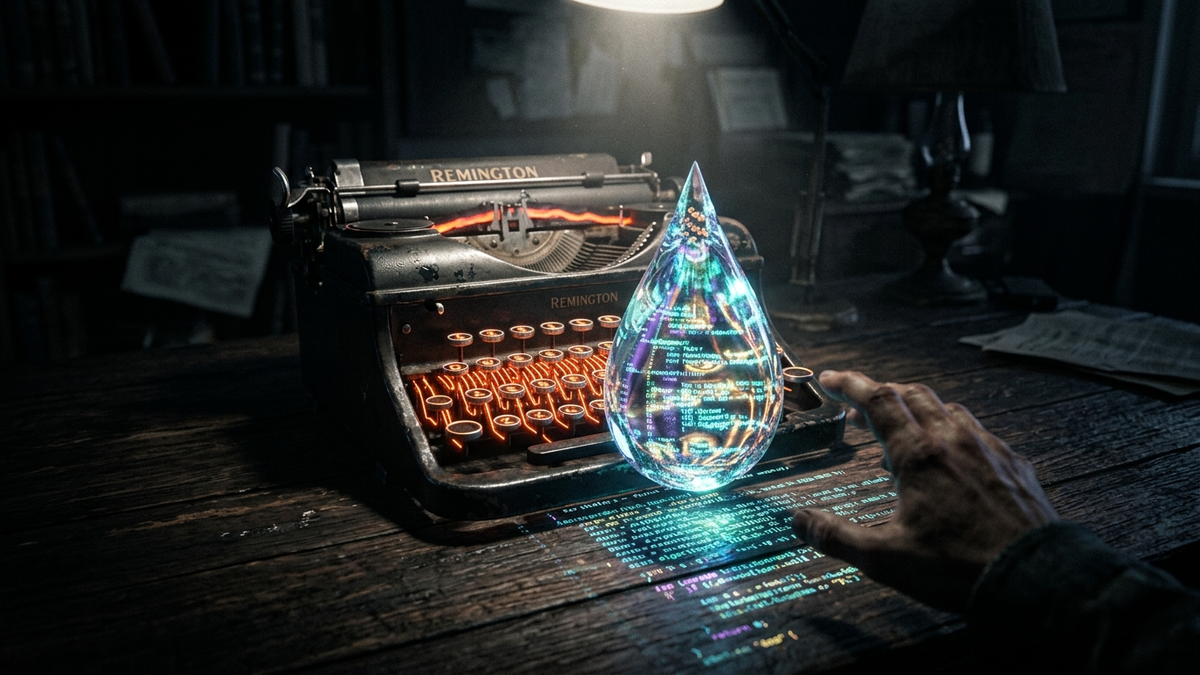
Can AI Write Fiction That Makes You Cry? The 2026 Turing Test for Emotion.
Quick Answer (TL;DR)
- Yes, but it's a cheat. AI can absolutely write a story that makes you cry by replicating proven emotional formulas and tropes it learned from its massive training data.
- It's pattern-matching, not feeling. The AI doesn't understand sadness or loss; it just knows which sequences of words are statistically associated with tear-jerking human writing. It's a masterful mimic without a soul.
- The real test isn't tears, it's authenticity. By 2026, the challenge won't be if an AI can trigger a basic emotion, but if it can create a nuanced, original, and emotionally authentic story that a literary expert can't distinguish from a human's.
Introduction
Forget the classic Turing Test. Asking if a machine can trick you into thinking it's human is a low bar in 2024. We get fooled by chatbots for customer service every day. The real test, the one that matters for the future of art and what it means to be human, is what I call the Emotional Turing Test. Can a machine write a story that doesn't just make sense, but makes you feel something so deeply that you physically cry? Not because you're sad for the robot, but because the story itself taps into a fundamental human truth.
I've spent 15 years in the trenches of IT and cybersecurity, watching systems evolve from dumb calculators to sophisticated neural networks. I've seen how they work from the inside—the code, the data, the raw logic. And I'm telling you, we're on the verge of a massive shift. The question is no longer "Can AI think?" but "Can AI make us *feel*?" Let's cut through the marketing hype and get down to the bits and bytes of synthetic emotion. By 2026, we'll have our answer, and it will change everything.
Section 1: The Ghost in the Machine: How AI "Learns" to Write a Story
First, let's get one thing straight. When we say an AI "learns," it's not like a child learning to ride a bike. An AI, specifically a Large Language Model (LLM) like GPT-4, is essentially the most complex pattern-matching engine ever built. Imagine you took every book, blog post, and screenplay on the internet and fed it into a giant statistical blender. The LLM analyzes all of it, not for meaning, but for relationships between words. It learns that the word "king" is often followed by "rules" or "queen," and that the phrase "a single tear rolled down" is statistically likely to appear in a sad scene.
It breaks everything down into numbers, or "tokens." The AI doesn't see "love," it sees token #2345. It learns that when token #182 ("death") and token #789 ("mother") appear in the same paragraph, token #2345 ("love") and token #567 ("grief") are highly probable follow-ups. It's all just a game of probabilities. It's not comprehending the raw, gut-wrenching pain of loss; it's just calculating the most statistically appropriate sequence of characters to represent that pain based on the millions of human-written examples it was trained on.
This is a critical distinction. The AI is a brilliant mimic. It can adopt the style of Hemingway because it has analyzed every word Hemingway ever published and can replicate his sentence structure and vocabulary. It can write a sonnet because it understands the rules of iambic pentameter and rhyme schemes. But it's all a performance, a sophisticated act of digital puppetry. The ghost in the machine isn't a soul; it's a probability matrix. It has the script to every play ever written but has never once felt the stage lights or heard the audience's applause.
So when an AI writes a story, it's not creating from a place of experience or emotion. It's assembling a story from the building blocks of human expression it has already seen. It's like a musician who can perfectly replicate any song they hear but can't compose an original melody because they don't understand the theory or emotion behind the notes. It's a flawless technical execution devoid of intent. And that's the first, and biggest, hurdle to writing something that genuinely moves us.
Section 2: The Empathy Gap: Why AI Fails at Genuine Emotion
This is where the rubber meets the road. An AI can describe a sunset perfectly. It can use all the right words: "crimson," "golden," "hues," "horizon." It can even write a poem about how that sunset makes a character feel nostalgic or hopeful. It can do this because it has ingested thousands of human descriptions of sunsets. But the AI has never *seen* a sunset. It has no eyes. It has no consciousness to experience the quiet awe of that moment. This is the empathy gap.
Emotion is rooted in lived, subjective experience—what philosophers call "qualia." It's the unique, personal feeling of redness, the sting of cold, or the complex, gut-punch of betrayal. An AI has zero lived experience. It has never scraped its knee, never had its heart broken, never felt the irrational surge of pride when a loved one succeeds. Its entire understanding of these concepts is secondhand, derived from our text. It's like a blind person becoming the world's leading art critic by reading books about paintings. They can tell you about brush strokes, color theory, and composition, but they can never know what it's truly like to *see* the Mona Lisa.
This is why AI-generated emotional content often feels hollow or slightly "off." It can hit the big, obvious emotional beats—a dog dying, a soldier returning home. These are tropes, well-worn paths in its training data. But it struggles with the subtle, contradictory, and messy reality of human emotion. It doesn't understand the bittersweet pain of watching your child grow up and leave home, or the strange mix of relief and guilt after a difficult but necessary goodbye. These are not simple, one-to-one correlations in a dataset. They are complex states that arise from a lifetime of context the AI simply doesn't have.
The AI can write, "He felt a profound sadness," but it has no internal reference for what that means. It's just outputting a high-probability phrase. To a human writer, that sentence is a doorway to a memory, a feeling, a physical sensation. To the AI, it's just token #987 following token #986. Until a machine can experience loss, it cannot truly write about it. It can only give us a very convincing echo of what we've already said on the subject.
Section 3: Deconstructing the Tear-Jerker: The AI's Toolkit for Emotional Manipulation
Okay, so the AI can't *feel*. But that doesn't mean it can't make *you* feel. Think of it like a hacker. I don't need to understand the deep philosophy of a corporation to breach its firewall. I just need to know the vulnerabilities, the protocols, and the right tools to exploit them. The AI is the same; it's an emotional hacker. It doesn't need to understand sadness to exploit the known vulnerabilities in the human emotional system.
Human emotion, especially in fiction, often responds to specific formulas and triggers. The AI has analyzed these formulas from millions of stories. It has a toolkit of tear-jerking devices it can deploy with ruthless efficiency. This includes deploying character archetypes we're hardwired to care about: the innocent child in peril, the loyal old dog, the mentor who sacrifices themselves for the hero. It knows that putting these characters in situations of loss, injustice, or noble sacrifice is a reliable way to trigger an empathetic response.
The AI is also a master of pacing and structure. It knows that building a deep connection to a character over several pages and then introducing a sudden, tragic event is far more effective than just starting with the tragedy. It can manipulate sentence structure, using short, punchy sentences to increase tension or long, flowing ones to create a sense of melancholy. It can identify and deploy "trigger words"—words like "alone," "forgotten," "goodbye," "forever"—that carry immense emotional weight and are statistically correlated with sad scenes in its training data. It's a calculated assault on your tear ducts, executed with the precision of a machine.
It's pure emotional arbitrage. The AI is taking the lowest-risk, highest-yield emotional tropes and combining them. The story of a brave, three-legged puppy who saves a dying orphan from a fire only to succumb to its injuries later? An AI can generate that in seconds. It will hit every beat perfectly. It will make you sad. But is it art, or is it just a perfectly executed piece of emotional malware?
💡 Expert IT Tip: You can use this "emotional hacking" yourself. When prompting an AI like Claude or GPT-4 for a story, be explicit with the formula. Don't just say "write a sad story." Say: "Write a 500-word story about a deep bond between two characters, establishing their shared history and inside jokes over the first 300 words. Then, introduce an element of sudden, unavoidable, and permanent separation. End with one character reflecting on a small, specific object that reminds them of the other." This structured prompting forces the AI to follow the classic emotional arc of connection-then-loss, dramatically increasing the impact.
Humanize your text and bypass any AI detector instantly with Undetectable AI.
BYPASS AI DETECTION NOWSection 4: The 2026 "Emotional Turing Test": My Blueprint for a Real Challenge
The current bar is too low. "Did it make you cry?" is a yes/no question that a well-written Hallmark card could pass. By 2026, we'll need a much more rigorous test, a real "Voight-Kampff" for synthetic authors. My blueprint for this Emotional Turing Test isn't about the presence of tears, but the *quality* of the emotion produced. It would be judged by a panel of literary critics, cognitive psychologists, and maybe even a few seasoned Hollywood script doctors.
Here are the key metrics we'd use to grill the AI's output:
- The Cliché Penalty: The AI's story would be algorithmically scanned for overused tropes. Does a character get diagnosed with a terminal illness right after finding true love? Does the dog die? Heavy penalties would be applied for relying on these emotional cheap shots. The goal is to test for emotional originality, not just replication.
- The Subtext Score: Can the AI convey emotion through what is *not* said? Real human emotion lives in the subtext—the awkward silence, the forced smile, the subject deliberately avoided. The panel would evaluate the story for its ability to create emotional depth through dialogue and action, rather than just stating "she was sad." This is brutally difficult for an AI, which tends to be very literal.
- Emotional Consistency and "Earned" Payoffs: Does the emotional journey of a character make sense? If a character has a massive emotional breakdown, was it properly set up and foreshadowed? Or was it just dropped in for shock value? The test would reward stories where the emotional climax feels earned and consistent with the character's established personality, a major weakness of current models that can lose the plot over long texts.
- The "Frisson" Factor: This is the big one. Can the AI produce a moment of genuine frisson—that physical, skin-tingling chill we get from a profound or shocking artistic revelation? This goes beyond simple sadness. It's the feeling of a sudden, deep understanding of the human condition. It's almost impossible to fake and is the hallmark of great human art.
Passing this test would mean an AI didn't just make someone cry with a story about a lost puppy. It would mean it wrote something with the emotional nuance and originality of a Kazuo Ishiguro novel or a Charlie Kaufman screenplay. That is the real mountain to climb, and I suspect it's a summit AI won't reach by 2026, or perhaps ever.
Section 5: The Human-AI Hybrid: The Real Future of Storytelling
So, if AI is just a brilliant but soulless mimic, is it useless for creative writing? Absolutely not. Thinking of AI as a replacement for a human author is the wrong framework. That's like asking if a new, top-of-the-line server rack can replace a system administrator. The server is an incredibly powerful tool, but it needs a human with experience and intent to direct it. AI in writing is the same: it's not the author, it's the ultimate co-pilot.
The real, practical future of AI in fiction is a human-machine partnership. A writer can use an AI to shatter writer's block. Stuck on a plot point? Feed the context to an AI and ask for ten different possible scenarios. Nine might be garbage, but one might spark the exact idea you needed. You can use it as a sparring partner, asking it to critique your pacing or suggest stronger verbs. It's an tireless assistant that has read more books than anyone in history.
Imagine this workflow: A human author has a core idea, a unique emotional truth they want to convey from their own life. They write a rough first draft. Then, they use an AI to "stress test" it. They might ask the AI to rewrite a chapter in the style of a different author to see their own work from a new perspective. They could ask it to identify potential plot holes or passages where the emotional intensity sags. The AI provides the data-driven analysis and endless variations, while the human provides the initial spark of creativity, the lived experience, and the final judgment call on what feels authentic.
This hybrid approach leverages the strengths of both parties. The AI handles the grunt work of generating options and analyzing text patterns, while the human handles the soul—the intent, the nuance, and the core emotional message. The final product isn't "AI-generated art." It's human art, augmented and accelerated by a powerful new tool. This is how we'll see AI used, not to replace novelists, but to create better ones.
💡 Expert IT Tip: For a powerful writer's workflow, use multiple specialized AI models. Use a model like GPT-4 with a large context window to hold your entire novel's outline and character bios for high-level plot consistency checks. Then, for specific scenes, paste the text into a model like Claude 3 Opus, which is often praised for its more nuanced and "poetic" prose generation, to get suggestions for refining dialogue and description. Using the right tool for the right job is key in IT, and it's just as true for creative AI.
Section 6: Red Teaming the Soul: Can We Ever Trust an AI's "Art"?
Now it's time to put on my cybersecurity hat. Every new technology has an attack surface, and the attack surface for emotionally resonant AI is the human mind itself. We're talking about the potential for emotional manipulation at a scale we've never seen before. Forget fake news articles. What happens when a bad actor can generate millions of unique, personalized, and emotionally compelling short stories designed to subtly shift public opinion on a political candidate or a social issue? It's weaponized narrative.
Imagine a story that makes you cry about a fictional family torn apart by a specific government policy. The story is perfectly crafted to bypass your rational brain and hit you straight in the gut. Now imagine millions of variations of that story, each tailored to the demographic profile of the person reading it, blanketing social media. This isn't just propaganda; it's a denial-of-service attack on public empathy, flooding the zone with synthetic feeling to drown out authentic discourse. How do we defend against that? How do we teach digital literacy for emotion?
This also raises a deep philosophical problem. If we can't distinguish AI art from human art, does the origin matter? A huge part of what gives art value is the story behind it—the artist's struggle, their intent, the piece of their life they poured into the work. If a beautiful poem that moves you to tears was generated in 0.7 seconds by a machine with no life experience, does that diminish its value? I argue that it does. It becomes a clever trick, a hollow spectacle. We're in danger of creating a world saturated with technically perfect but soulless content, devaluing the very human struggle that makes art meaningful in the first place.
We'll need new security protocols for culture. This could mean things like mandatory digital watermarking for all AI-generated media, so we at least know the origin of what we're consuming. We'll need a new kind of critical thinking that questions the emotional authenticity of a story, not just its factual accuracy. We need to "red team" the very concept of synthetic art, to find its vulnerabilities before they are used against us on a massive scale. The firewall we need to build isn't for a network; it's for the human heart.
Conclusion
So, can AI write fiction that makes you cry? Yes. The technical answer is an unequivocal yes. An advanced LLM can analyze the formula for a tear-jerker and execute it with brutal, mathematical precision. It can assemble the right words in the right order to press our emotional buttons, and we will respond.
But that's the wrong question. The right question is, "Can AI create a story with authentic, original, and earned emotion that reveals a deeper truth about being alive?" On that front, the answer is a hard no. It's a mimic, an echo, a ghost in the machine that only knows how to recite the lines it has been fed. It has no life, no loss, no love to draw from. It's running `human_sadness.exe`, but it has no idea what it means.
The 2026 Emotional Turing Test, as I see it, won't be a celebration of AI's success. It will be a stark reminder of the gap that technology can never cross—the gap of lived experience. AI will be an incredible tool for human creators, a co-pilot that will help us tell our own stories better and faster. But it will never be the storyteller. For that, you need a soul. And last I checked, there's no API for that.
Don't wait for the headlines. Our Private Telegram Channel delivers real-time AI security updates and digital wealth strategies before they go viral. Stay protected. Stay ahead.
⚡ JOIN THE 1% NOW🧰 Try Our Free Tools & Calculators
No sign-up required. Instantly check risks, analyze AI text, or calculate your digital finances.