Decentralized Finance (DeFi) Traps: How to Spot a "Liquidity Drain" Fast
Quick Answer (TL;DR)
- Check the Liquidity Pool (LP): Use a block explorer like Etherscan to see if the LP tokens are sent to a time-lock contract. Unlocked liquidity means the developers can pull all the money out at any second.
- Analyze Token Distribution: Look at the "Holders" tab for the token. If a few non-contract wallets hold a massive percentage of the supply, they can dump the price to zero, leaving you with worthless bags.
- Verify The Socials & Contract: Anonymous teams, disabled comments, and bot-filled Telegram groups are huge red flags. Use a token scanner to check for malicious functions like a honeypot (you can't sell) or a proxy contract (they can change the rules later).
Introduction
Alright, let's cut the crap. Decentralized Finance isn't some utopian future garden; it's the Wild West, complete with gold rushes and highway robbery. I've spent 15 years locking down corporate networks, and I'm telling you, the scams in DeFi make phishing emails look like child's play. The most common and brutal of these is the "liquidity drain," also known as a rug pull. It's fast, it's devastating, and it's designed to exploit your greed and your trust.
Think of it this way: a scammer builds a beautiful-looking new bank (a DeFi project). They convince you and hundreds of others to deposit your gold (Ethereum, BNB, etc.) into the vault in exchange for "bank notes" (the new token). The moment that vault is full enough, they don't use a key to open the front door; they blow a hole in the back wall they built themselves and vanish with every last ounce of gold. Your bank notes are now worthless pieces of paper.
This guide isn't academic theory. This is a field manual from the trenches. We're going to skip the buzzwords and give you a practical, step-by-step sysadmin's checklist for inspecting these projects. My goal is to make you so paranoid and methodical that scammers will see you coming and run the other way. Let's get to work.
What the Hell is a Liquidity Drain, Anyway? (The Setup)
Before you can spot the trap, you need to understand how it's built. The whole scam hinges on something called a "Liquidity Pool" (LP). Forget the complex math for a second. An LP is just a big pot of money that traders use. It contains two different tokens: a well-known one like Ethereum (ETH) and the project's new, shiny token (let's call it SCAMcoin). This pot allows anyone to instantly swap their ETH for SCAMcoin, and vice-versa, without waiting for a buyer or seller.
To create this pot, the project's developers—the scammers—are the first to "provide liquidity." They put in, say, 10 ETH and a billion SCAMcoins. In return, the system gives them "LP tokens," which are basically a receipt that proves their share of the pot. Now, they encourage you, the investor, to buy in. You see the hype, you swap your valuable ETH for SCAMcoin. As more people buy, the amount of ETH in the pot grows, and the price of SCAMcoin goes up. This is where the trap is set.
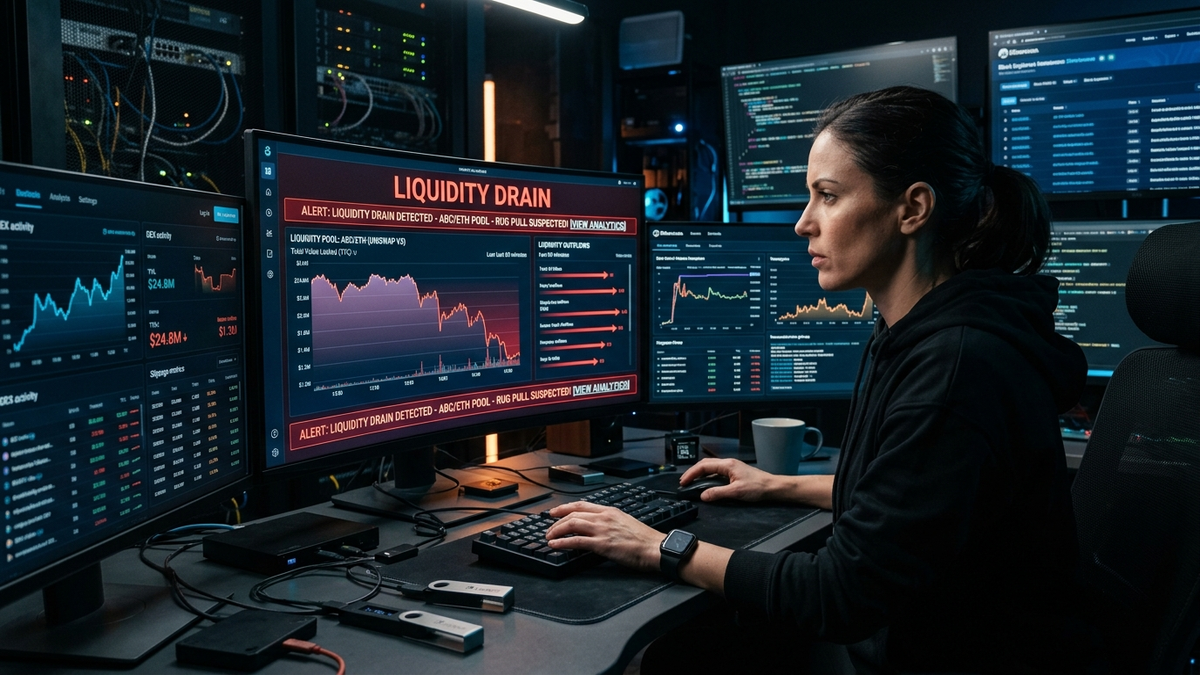
A "liquidity drain" is the moment the scammers cash in their receipt. They use their LP tokens to withdraw their share of the pot. But since the pot is now full of investors' ETH and they own most of the LP tokens, they don't just take their original 10 ETH back. They take *all* the ETH, leaving behind a worthless pile of SCAMcoin. The value of your holdings instantly vaporizes. This happens in a single, catastrophic transaction. Your screen will show a 99% drop in less than a second.
There are two main flavors of this attack. The first is the classic "rug pull" I just described, where they literally pull the liquidity. The second is a "soft rug," where the developers hold a massive bag of SCAMcoin themselves. They wait for the price to pump and then just dump their entire stash on the market, crashing the price to zero. The outcome is identical: they walk away with real money, and you're left with nothing. Understanding this mechanism is the first step to not becoming a victim.
The Red Flags in the Smart Contract Itself (Code is Law, and Sometimes the Law is a Trap)
You don't need to be a programmer to do a basic health check on a smart contract. You just need to know where to look for the obvious signs of poison. The blockchain is transparent, and these scammers rely on you being too lazy or too excited to check the public record. We're going to fix that right now. Your number one tool here is the block explorer for the relevant chain, like Etherscan for Ethereum or BscScan for BSC.
First and foremost is Liquidity Locking. This is non-negotiable. When developers provide liquidity, they should immediately send their LP tokens (the receipt for the pool) to a third-party time-lock contract. This makes it impossible for them to withdraw the liquidity for a set period, like one year. If the liquidity is not locked, it means they can pull it out at any moment. You can check this on a token scanner or by looking at the LP token holders on the block explorer. If the top holder is a wallet and not a known locker contract (like Unicrypt or DxSale), it's a ticking time bomb. Run.
Next, you need to check the contract's permissions. On the block explorer, find the token's address and click the "Contract" or "Read Contract" tab. Look for anything that gives the owner god-mode powers. A huge red flag is a `mint()` function. This allows the owner to create new tokens out of thin air, diluting the supply and allowing them to dump infinitely. Another is a `setTax()` function that can be changed at will. A scammer can wait for you to buy and then set the sell tax to 99%, effectively trapping your funds. A legitimate project will "renounce ownership" of the contract after launch, which severs these administrative controls forever. If the owner's address is still active, you are trusting a stranger with root access to your money.
Finally, watch out for the classic Honeypot. This is a special kind of trap where the contract code is written to allow buys, but not sells (except for whitelisted addresses, like the developer's). The chart will look amazing—a sea of green buys with no sells—creating insane FOMO. People pile in, not realizing their money is already gone because they can never cash it out. The scammer is the only one who can sell, and they will drain all the money once the buying frenzy peaks. Always use a dedicated honeypot-checking website before you buy any new token. It takes five seconds to paste the contract address and get a simple yes/no answer.
💡 Expert IT Tip: Look out for overly complex or unverified contracts. Scammers sometimes use a "proxy contract" pattern. The contract you interact with is just a shell that points to another contract containing the real logic. The owner can change this pointer at any time, "upgrading" the contract to a malicious version that drains your funds. If you see functions like `delegatecall` or references to an "implementation" contract, and you don't fully understand it, stay away. It’s like a server that lets the admin hot-swap the operating system without rebooting—powerful, but in the wrong hands, catastrophic.
Social Engineering & Hype Manipulation (The Human Element of the Scam)
The most brilliant malicious code in the world is useless if no one buys the token. That’s why the real con happens on the social layer. Scammers are masters of psychological manipulation, and they build a sophisticated theater of hype to lure you in. They're not just selling a token; they're selling a dream of getting rich quick, and they prey on your Fear of Missing Out (FOMO).
The first thing to investigate is the team. Are they anonymous? While Satoshi Nakamoto was anonymous, 99.9% of anonymous DeFi projects are run by people who want zero accountability when they steal your money. Look for a "doxxed" team with real names, real LinkedIn profiles, and a verifiable history in tech or finance. A cartoon profile picture and a name like "CryptoKing" is not a team; it's a character designed to disappear. If they won't put their reputation on the line, you absolutely should not put your capital on the line.
Next, scrutinize their public-facing materials. A flashy website means nothing; you can get a template for under $100. The whitepaper is where you should focus. Is it full of vague buzzwords like "decentralized synergy," "AI integration," and "Web3 paradigm"? Or does it clearly explain a specific problem and a unique, technical solution? Copy and paste a few paragraphs into Google. You'd be shocked how many "revolutionary" whitepapers are just plagiarized from other projects. A lazy whitepaper signals a lazy, or more likely, a fraudulent project.
The community channels like Telegram and Discord are the primary battlegrounds for hype. Be deeply skeptical of what you see. Scammers use thousands of bots to create the illusion of a massive, excited community. Look for repetitive, low-effort messages like "LFG!", "When moon?", and endless rocket emojis. A real community has intelligent discussion, debates, and critical questions. In a scammer's channel, try asking a tough question, like "Can you show me the transaction for the liquidity lock?" or "Why does one wallet hold 40% of the tokens?" If your question is ignored, deleted, or you are immediately banned, you have your answer. It's a dictatorship, not a community, and they're just trying to keep the positive illusion going long enough to drain the liquidity.
On-Chain Forensics for Dummies (Following the Money Before It's Gone)
The blockchain is a public ledger. Every single transaction is recorded forever. This is a nightmare for criminals if you know how to read it. You don't need a forensics degree; you just need to learn how to use a block explorer as an investigative tool. This is how you verify the claims made on social media. Don't trust, verify on-chain.
Humanize your text and bypass any AI detector instantly with Undetectable AI.
BYPASS AI DETECTION NOWYour first stop is the Token Holders chart. On Etherscan or BscScan, paste the token's contract address and click the "Holders" tab. This page is the single most important piece of due diligence you can do. It shows you exactly which addresses hold what percentage of the total supply. Ignore the #1 holder if it's a "burn address" (a dead wallet) or the #2 holder if it's the liquidity pool on an exchange like Uniswap. Look at the top 10-20 actual wallets after that. Do you see multiple wallets holding 5%, 8%, or 10% of the total supply? This is an enormous red flag. It means the token distribution is centralized, and any one of these "whales" can crash the price to zero by dumping their entire bag. A healthy distribution has thousands of holders with no single entity holding a threatening amount.
Next, dig into the liquidity pool itself. On a site like DEXTools, you can find the address for the trading pair (e.g., WETH/SCAMcoin). Put that address into the block explorer and look at *its* holders. Remember, people who provide liquidity get LP tokens back. If one wallet holds 80-90% of those LP tokens and you've already confirmed they aren't in a time-lock contract, you are literally looking at the rug puller's wallet. They are holding the key to the entire vault. It’s not a matter of *if* they will pull it, but *when*.
For a more advanced check, trace the creator's wallet. Find the transaction that created the token contract. Look at the "From" address. This is the deployer. Now, click on that address and examine its history. Is it a brand-new wallet created just a few days ago? Did it receive its funding (the gas money to create the contract) from a privacy mixer like Tornado Cash? These are classic signs of a professional scammer trying to cover their tracks. A legitimate founder will often have a long history of activity on their wallet. A ghost wallet that appears out of nowhere, creates a token, and funds a bunch of other new wallets is a five-alarm fire.
💡 Expert IT Tip: Don't just rely on the raw block explorer. Use a portfolio tracker or blockchain analysis tool like Arkham or Zerion. Paste the contract address or a suspicious whale's wallet address into their search bar. These tools provide a much cleaner, human-readable dashboard. They aggregate data and can help you visualize where a wallet received its funds from and where its assets are, often with clear labels for exchanges, bridges, and known scammer addresses. This turns a confusing list of transactions into an actionable intelligence report.
Practical Tools of the Trade (Your Digital Toolkit for Due Diligence)
Walking into a new DeFi project without the right tools is like a sysadmin trying to debug a server with a blindfold on. You need a specific set of utilities to scan, verify, and monitor before you risk a single dollar. These tools are your first line of defense and will filter out 90% of the low-effort scams automatically. Make using them a mandatory part of your pre-investment checklist.
First up are the Token Scanners. Websites like Token Sniffer or GoPlus Security's Token Security Detection are indispensable. You simply paste the token's contract address into their search bar, and they run an automated audit in seconds. They check for a dozen critical vulnerabilities at once. Is the contract source code verified? Does it contain a honeypot function? Is the liquidity burned or locked? Does the owner retain dangerous permissions like minting or disabling trading? These scanners will give you a summary score and a list of specific warnings. If a token gets a bad score here, you don't need to investigate any further. Just close the tab and move on. It's a quick, effective "no-go" gauge.
Next are the DEX Screeners like DEXTools and DexScreener. Most people use these just to watch the price chart, but their real value is in the data panels. Look for the "Pool Info" or "Security" sections. They often have direct links to the liquidity lock and will show you the percentage of liquidity that is secured and for how long. Furthermore, watch the live transaction feed. Is it a constant stream of buys with very few, small sells? That's a real-time indicator of a potential honeypot. A healthy token has a mix of both buyers and sellers. An endless wall of green is suspicious, not bullish.
Never forget the basics: the Block Explorers (Etherscan, BscScan, Solscan, etc.). This is your source of absolute truth. All the other tools pull their data from here. Learning to do your own basic checks on the explorer is a superpower. You can personally verify the holder distribution, check the contract code for mint functions, and see exactly where the LP tokens are held. Don't just trust a scanner's summary; learn to confirm its findings yourself. This skill will protect you when scammers invent new traps that automated tools haven't been programmed to detect yet.
💡 Expert IT Tip: Compartmentalize your operations. Create a completely separate browser profile (e.g., in Chrome or Brave) for all your DeFi activity. Install a fresh MetaMask wallet in that profile that is used *only* for interacting with new, unaudited contracts. Fund it with small amounts of crypto you are fully prepared to lose. This is called sandboxing. If you accidentally interact with a malicious contract that drains wallets, it will only be able to steal the "play money" in your sandboxed wallet, leaving your main, high-value savings in your other, isolated wallet completely untouched. It's the digital equivalent of not using your admin password for daily web browsing.
The Post-Mortem: What to Do if You Get Hit (Damage Control & Reporting)
Even with the best preparation, mistakes can happen. A sophisticated scam can fool even seasoned experts. If you find yourself on the receiving end of a liquidity drain, the key is to avoid panic and take immediate, methodical steps to contain the damage and protect yourself from follow-up attacks. The money from the scam is almost certainly gone, but the situation can always be made worse.
Your absolute first move is to Revoke Permissions. When you use a decentralized exchange, you give the contract "approval" to spend your tokens. A malicious contract might not drain your wallet instantly. Instead, it might have an unlimited approval to pull other assets from your wallet at a later time. Go immediately to a trusted utility like Revoke.cash. Connect your wallet, and it will show you a list of every single contract you've ever granted permissions to. Find the scam token's contract and any other suspicious approvals and click "Revoke." This costs a small gas fee but is the most critical step to prevent further losses. It's like calling your bank to cancel a stolen credit card before the thief can use it again.
Brace yourself for follow-up scams. Criminals know you're desperate. You will likely get DMs on Telegram or Discord from people pretending to be "official support" or "recovery agents." They will offer to help you get your money back. This is *always* a lie. Their goal is to trick you into sending them more money for a "recovery fee" or to get you to visit a phishing site that will drain the rest of your wallet. No one can reverse a blockchain transaction. Block anyone who contacts you with an offer to help. Legitimate support will never DM you first.
While it may feel futile, you should report the incident. Take screenshots of everything. Get the scammer's wallet addresses and the token contract address. Report them on the relevant block explorer (Etherscan and BscScan have report features). Report their social media accounts to Twitter, Telegram, etc. Submit the information to major exchanges like Binance and Coinbase, as the scammers will eventually try to cash out their stolen funds through one of them. This helps get their accounts and wallets flagged, making it harder for them to operate and potentially protecting the next victim.
Finally, face the hard reality and handle the administrative fallout. The funds are gone. Do not send money to anyone promising to get them back. Your only recourse is to treat it as a capital loss for tax purposes. Consult a tax professional who is knowledgeable about cryptocurrency. Document the date, the amount lost, the transaction hashes, and any evidence you have of the scam. This financial and emotional blow is a harsh lesson, but it's one you only need to learn once. Use the experience to refine your security checklist and become an even more vigilant investor.
Conclusion
Navigating DeFi is not about finding the next 100x moonshot. It's about risk management. It's about survival. The landscape is littered with the digital corpses of investors who let FOMO override their common sense. Every new project, no matter how exciting the hype, must be approached with a default setting of deep, methodical paranoia. Trust nothing and verify everything on-chain.
The difference between a victim and a survivor in this space is a process. It's having a checklist and following it religiously for every single investment, no matter how small. Check the liquidity lock. Analyze the holders. Read the contract for malicious functions. Scrutinize the team. Use the tools. This isn't just financial advice; it's basic cybersecurity hygiene applied to your capital.
Don't let the sharks scare you out of the water for good. The technology underpinning DeFi is genuinely transformative. But for now, it's an unregulated frontier. You are your own bank, and that means you are also your own head of security. Act like it. Be the sysadmin of your own wallet: be skeptical, be thorough, and always, always check the
Don't wait for the headlines. Our Private Telegram Channel delivers real-time AI security updates and digital wealth strategies before they go viral. Stay protected. Stay ahead.
⚡ JOIN THE 1% NOW🧰 Try Our Free Tools & Calculators
No sign-up required. Instantly check risks, analyze AI text, or calculate your digital finances.