Hardware Wallet Seed Phrase Storage: The Definitive 2026 Guide
Quick Answer (TL;DR)
- Ditch Paper, Embrace Metal: Your primary backup MUST be physically stamped or etched into a fireproof, waterproof metal plate (stainless steel or titanium). Paper is a guaranteed point of failure due to fire, water, and decay.
- Redundancy is Not Optional: Create at least two identical metal backups and store them in geographically separate, secure locations. A single location, even a safe, is a single point of failure.
- Never, Ever Go Digital: Your seed phrase must NEVER touch any online or digital device. No photos, no cloud storage, no password managers, no text files. This is the cardinal sin of self-custody.
Introduction
Alright, let's get one thing straight. That shiny new hardware wallet you bought isn't the vault. It’s just the key. The real vault, the one that holds the deed to your entire crypto portfolio, is that list of 12 or 24 words it spat out when you set it up. That's your seed phrase, or more accurately, your recovery phrase. If your device gets smashed, stolen, or fried, the seed phrase is the only thing that lets you get your assets back. Conversely, if a thief gets their hands on that phrase, your hardware wallet is as useless as a screen door on a submarine. They don't need your device or your PIN; they can drain your accounts from anywhere on the planet.
For the next 15 minutes, forget everything you think you know about "safe" storage. We're not talking about hiding a piece of paper in a book or taking a "quick" photo of it. Those are amateur moves that will get you rekt. I've spent 15 years in the trenches of cybersecurity, watching people lose fortunes because of one tiny, lazy mistake. This guide is your battle plan for 2026 and beyond. It's about building a fortress around those words, using methods that can withstand fire, flood, theft, and your own forgetfulness. Your financial sovereignty depends on it.
Section 1: The Threat Model: Why Your Current Method is Probably Garbage
Before we build a fortress, we need to understand the enemy. In cybersecurity, we call this "threat modeling." It’s a fancy way of asking, "How could I possibly lose everything?" Let's be brutally honest about the common methods people use and why they are fundamentally broken. The number one enemy isn't a shadowy hacker in a hoodie; it's a combination of physical disaster and human laziness. People optimize for convenience, but in this game, convenience is the sworn enemy of security.
First up, the classic: the piece of paper. You wrote your 24 words on the little card that came with your wallet and tucked it in a desk drawer or a safe. This is a catastrophic failure waiting to happen. What happens in a house fire? Paper burns at 451°F (233°C), but a typical house fire can easily exceed 1,500°F (815°C). Your paper is now ash, and so is your crypto. What about a flood or a burst pipe? That ink will run, blur, and become completely unreadable. Even time is an enemy; ink fades, and paper degrades. A fireproof safe might help, but many are only rated to keep internal temperatures below 350°F—still hot enough to char paper into illegibility.
Then we have the "clever" digital methods. This is where I see the most face-palm-worthy mistakes. You took a photo of your seed phrase and it's now in your Google Photos or iCloud. You've just handed the keys to your kingdom to any hacker who can compromise your cloud account. You saved it in a text file called `words.txt` on your laptop. Now, every piece of malware, every keylogger, every remote access trojan that ever infects your machine has a direct line to your life savings. "But I put it in my password manager!" you say. While password managers are great for website logins, they are a massive, centralized target. A breach of your password manager service or a compromise of your master password means an attacker gets everything, including your seed phrase. The core principle is simple: the seed phrase must never exist in any format that is connected to the internet or can be read by a computer. It is analog-only, forever.
Finally, there's physical theft. Hiding your paper or even a metal plate in an obvious place like a home safe is a rookie mistake. A determined burglar who knows what they're looking for will go straight for the safe. They'll either crack it on-site or just take the whole thing with them. Thinking you can outsmart a thief by hiding it in a hollowed-out book is movie-plot nonsense. You need layers of security, redundancy, and obfuscation, because relying on a single secret hiding spot is just gambling.
Section 2: The Foundation: Metal, Metal, and More Metal
The absolute, non-negotiable baseline for secure seed phrase storage is metal. We're not talking about a flimsy aluminum dog tag; we need industrial-grade materials that laugh in the face of physical disasters. The goal is to create a backup that can survive your house burning to the ground and then being hosed down by the fire department. Paper fails. Metal endures.
The "why" is simple physics. Stainless steel (specifically 304 or 316 grade) has a melting point of around 2,550°F (1,400°C), and titanium melts at over 3,000°F (1,670°C). Both are well above the temperature of a standard house fire, ensuring your seed words remain physically intact. They are also completely waterproof and highly resistant to corrosion and crushing. This isn't an upgrade; it's the minimum requirement for anyone serious about self-custody. There are many products on the market, from brands like Cryptosteel, Billfodl, and countless others, that offer pre-made kits.
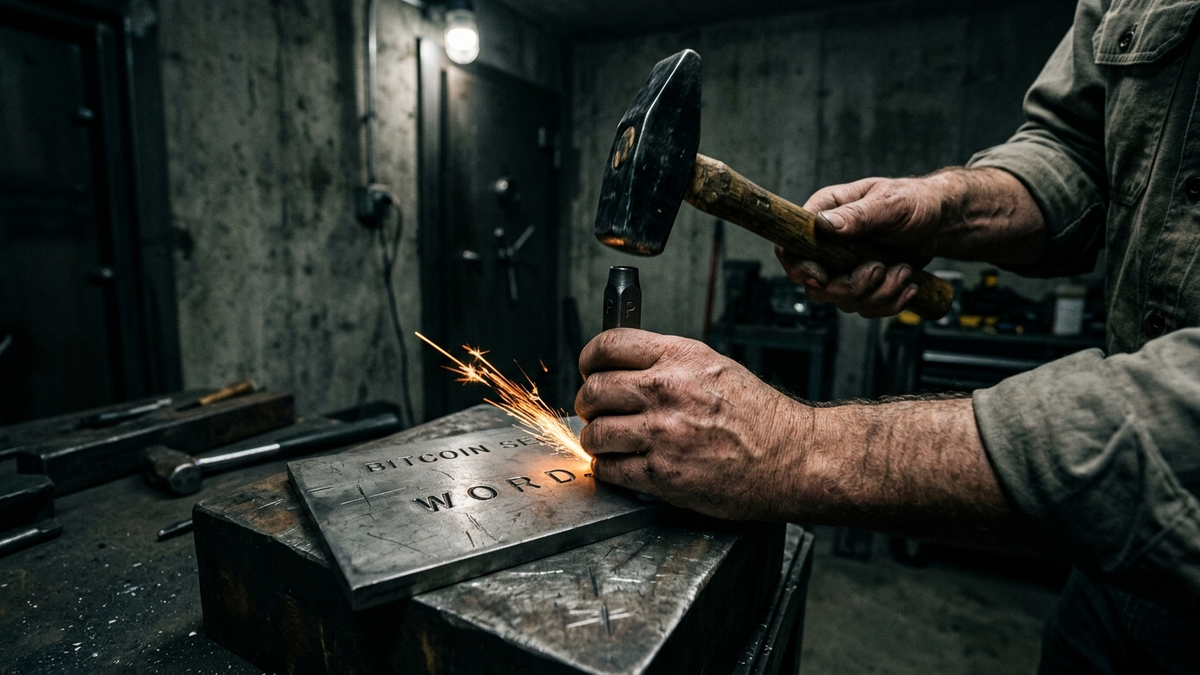
There are two primary methods for getting your words onto the metal: stamping and etching. Stamping involves using a set of steel letter punches and a hammer to physically indent each letter of your words into a thick metal plate. This is, by far, the most durable method. The indentations will survive intense heat, abrasion, and impact. Etching, often done with an electric engraving pen, is easier and quieter but less robust. The engraved lines are shallower and could potentially be obscured by heavy corrosion or warped in an extreme fire. My professional advice is to always choose stamping. It’s loud, it takes effort, but the result is a nearly indestructible artifact.
The process is straightforward but requires absolute focus. Lay your metal plate on a solid surface, like a steel bench block or a sturdy workbench (don't do this on your kitchen table). Take the first four letters of each word from the BIP-39 word list (you only need the first four to uniquely identify any word) and carefully, one by one, stamp them into the plate. Double-check your spelling. Triple-check the word order. A single mistake—one wrong letter, two words swapped—will render the entire backup useless. Work slowly, methodically, and without distractions. This 30-minute process is one of the most financially important tasks you will ever perform.
💡 Expert IT Tip: Don't buy a cheap, flimsy letter punch set. Go to a hardware or industrial supply store and get a hardened steel 1/4 inch (6mm) set. They provide deeper, cleaner impressions. Before you touch your real plate, buy a cheap piece of scrap steel and practice stamping a few random words. Get a feel for the hammer force needed. When you do the real one, use a strip of painter's tape to create a straight line to guide your letters, ensuring they are neat and readable.
Section 3: Advanced Defense: Geographic Distribution & Decoys
Okay, so you've stamped your seed phrase into a solid titanium plate. You've won, right? Wrong. You've just created the world's most valuable coaster. Now, what happens if a burglar who knows what a seed plate is specifically targets your home and finds it? What if a natural disaster, like a localized tornado or earthquake, completely obliterates your property and the plate is lost in the wreckage? You've solved the durability problem, but you still have a massive "single point of failure" problem. The solution is redundancy through geographic distribution.
This concept is dead simple: don't keep all your eggs in one basket. You need to have at least two, preferably three, identical copies of your metal seed phrase backup stored in locations that are physically separate and have different risk profiles. This means they shouldn't all be in the same city, if possible. For example, you could keep one in a well-hidden spot in your own home. The second could be stored in a bank's safe deposit box. The third could be entrusted to a close, highly-trusted family member in a different state or even country, sealed in a tamper-evident bag.
Secure your digital wealth with the world's most trusted hardware wallets.
GET YOUR WALLET NOWThe key here is that a single event cannot wipe out all your backups. A house fire won't affect the bank vault. A bank failure or seizure (a "bail-in") won't affect the one at your parents' house. This multi-location setup protects you from theft, loss, and even government seizure. The cost of a few extra metal plates and a safe deposit box is pocket change compared to the value they are protecting. This isn't paranoia; it's professional-grade risk mitigation. In IT, we never rely on a single backup for critical data, and your seed phrase is the most critical data you will ever own.
Now let's add another layer: deception. For the backup you keep at home, create a decoy. Go buy a cheap, obvious-looking fireproof safe. Inside that safe, place a less-secure backup—maybe an etched steel plate or even a laminated piece of paper—for a "honeypot" wallet. This wallet should have a small, but not trivial, amount of crypto in it, maybe a few hundred dollars' worth. A common thief will break into your house, find the safe, crack it open, find the seed phrase, and think they've hit the jackpot. They'll leave with their prize, never knowing that your real, multi-million dollar backup is stamped on a titanium plate hidden somewhere else entirely. This psychological trick satisfies the attacker's goal and encourages them to leave the premises quickly, ending their search for more valuables.
Section 4: The Endgame for High-Value Holders: Multi-Signature & Shamir's Secret Sharing
When you're dealing with life-changing amounts of money, a single seed phrase—no matter how well you store it—can become a terrifying liability. A single point of failure isn't just about loss or damage; it's also about coercion. This is the infamous "$5 wrench attack" or rubber-hose attack: a thief doesn't need to hack you if they can physically threaten you into giving up your seed phrase. For this, we need to eliminate single points of failure at the cryptographic level. The two leading technologies for this in 2026 are Multi-Signature (Multisig) and Shamir's Secret Sharing (SSS).
Multi-Signature is the gold standard for security and is conceptually easier to grasp. Think of it like a joint bank account that requires two signatures to release funds, or a missile silo that needs two officers to turn their keys simultaneously. A multisig wallet is a special type of address that is controlled by multiple private keys. You might set up a "2-of-3" multisig wallet. This means you have three separate hardware wallets, each with its own unique seed phrase. To authorize a transaction from the multisig wallet, you need to sign it with any two of those three devices. Now, your security model is completely transformed. You can store each of the three hardware wallets and their corresponding metal seed phrase backups in three different locations around the world. An attacker who gets one seed phrase gets nothing. A thief who steals one hardware wallet gets nothing. The person threatening you with a wrench gets nothing, because you physically cannot authorize the transaction by yourself. This is how you defeat coercion.
Shamir's Secret Sharing (SSS) is a different approach that splits the secret itself. Instead of creating multiple keys, SSS takes your single seed phrase and splits it into a number of unique "shares." You can configure it as a "3-of-5" scheme, for example. This process generates five shares. The magic is that any three of those five shares can be used to perfectly reconstruct your original seed phrase, but having only one or two shares is mathematically useless; it reveals zero information. You can then distribute these five metal-stamped shares to five different locations or trusted people. This provides incredible redundancy. If a fire destroys one share and a relative loses another, you can still recover your funds with the remaining three. However, SSS comes with a massive warning: it is more complex to manage, and if you lose too many shares (in a 3-of-5, if you lose three shares), your funds are permanently and irrevocably lost. It's a powerful tool, but it's less forgiving than multisig.
💡 Expert IT Tip: For setting up a robust multisig wallet, don't try to roll your own solution unless you're a developer. Use battle-tested, user-friendly platforms. For Bitcoin, services like Unchained Capital or Casa provide guided setup and hold one of the keys in a secure, insured custody arrangement, making the process much safer for non-technical users. For more advanced users, desktop software like Sparrow Wallet or Specter Desktop provides powerful, open-source tools to manage your own multisig setup with multiple hardware wallet brands.
Section 5: Operational Security (OpSec): The Human Element
All the fancy metal plates and multisig schemes in the world are worthless if you have sloppy personal habits. Operational Security, or OpSec, is the set of practices you use to protect yourself during the entire lifecycle of your seed phrase, from generation to storage to recovery. It’s about managing the human element, which is almost always the weakest link in any security system. This is the stuff that requires discipline, not just technology.
First, consider the generation ceremony. When your hardware wallet generates your 24 words, where are you? Are you at a public library on their Wi-Fi? Are you in your office with security cameras overhead? The ideal environment is a private, secure room with no cameras or microphones. Your computer should be trusted and free of malware. For the truly paranoid, the best practice is to use a brand new, air-gapped computer (one that has never and will never connect to the internet) to interface with the hardware wallet, but for most users, a clean personal machine is sufficient as long as the seed phrase is only ever displayed on the hardware wallet's trusted screen, never on the computer monitor.
Next is the absolute, unbreakable rule of no digital traces. I've said it before, but it bears repeating with brutal clarity. The moment you type your seed phrase into a computer, take a photo of it with your phone, or read it aloud to a voice assistant, you must consider it compromised. There is no middle ground here. Digital data is promiscuous; it gets copied, backed up to clouds, indexed by operating systems, and can persist in memory or on hard drives even after you "delete" it. When you are stamping your metal plate, you use the hardware wallet screen and a piece of paper for temporary transcription, and then you securely destroy that piece of paper immediately after. Burning it to ash is the preferred method.
Finally, and this is the part almost everyone forgets, you need an inheritance plan. What happens to your assets if you die or become incapacitated? Your impenetrable security system will work perfectly, locking your family out of your wealth forever. This is a real and devastating problem. You must create a clear, foolproof plan for your next of kin. This could involve a sealed letter or package stored with a trusted estate lawyer, to be opened only upon presentation of a death certificate. This package should contain the location of one or more of your seed phrase backups and explicit, step-by-step instructions on how to perform a recovery. Don't just give them the words; explain what they are, what a hardware wallet is, and who they can trust (and not trust) for help. Your OpSec plan is incomplete until it accounts for your own demise.
Conclusion
Look, securing a seed phrase isn't a one-and-done task you check off a list. It's an ongoing discipline. The methods we've covered—moving from fragile paper to indestructible metal, from a single hiding spot to geographic distribution, and for serious holders, graduating to coercion-resistant multisig—are not suggestions. In 2026, they are the standard of care for anyone who values their digital property. You are your own bank, and that means you must also be your own security chief.
Don't cut corners. Don't optimize for convenience. The 90 minutes it takes to properly stamp and store two metal plates could be the difference between a secure financial future and a post on Reddit titled, "I lost my life savings, please help." The threats are real, but they are manageable if you are deliberate, disciplined, and just a little bit paranoid. Your seed phrase is the master key to your digital life; it is pure financial sovereignty in 24 words. Guard it accordingly.
Don't wait for the headlines. Our Private Telegram Channel delivers real-time AI security updates and digital wealth strategies before they go viral. Stay protected. Stay ahead.
⚡ JOIN THE 1% NOW🧰 Try Our Free Tools & Calculators
No sign-up required. Instantly check risks, analyze AI text, or calculate your digital finances.