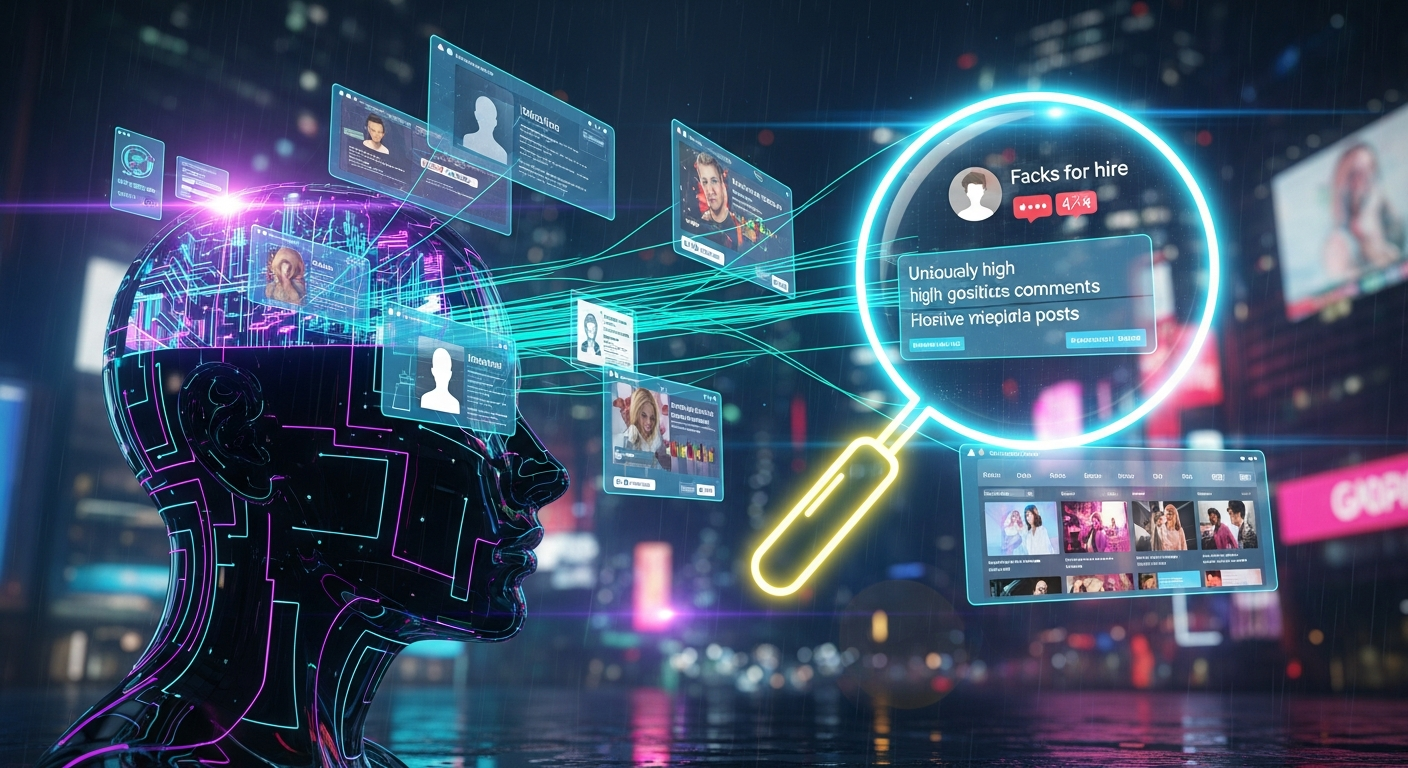
Navigating the Digital Deception: Unmasking the Professional 'Liar for Hire' on Social Media
Quick Answer (TL;DR)
- Look for profiles with inconsistent digital footprints, including sparse history, generic content, and sudden shifts in focus or persona.
- Identify unnatural engagement patterns such as overly positive/negative comments, lack of genuine interaction, or identical responses across multiple suspicious accounts.
- Scrutinize content red flags like generic stock photos, plagiarized text, extreme or emotionally manipulative narratives, and unusual, often synchronized, posting schedules.
- Employ verification tools like reverse image searches (e.g., TinEye, Google Images), cross-platform profile checks, and domain WHOIS lookups to expose fabricated identities and claims.
- Recognize psychological manipulation tactics, including gaslighting, virtue signaling without substance, and aggressive deflection when challenged, which often indicate a paid agenda.
The digital landscape, a vibrant tapestry of connection and information, harbors a shadowy underbelly where truth is a commodity and authenticity a performance. In this arena, a new breed of mercenary operates: the professional "liar for hire." These individuals, often part of sophisticated networks or operating as solo agents of deception, are paid to manipulate narratives, discredit reputations, amplify falsehoods, or engineer public opinion on social media platforms. Their work is insidious, eroding trust and distorting reality, making it increasingly challenging for the average user to discern genuine interaction from calculated artifice. Understanding their methods is not merely an academic exercise; it is a vital skill for digital literacy, crucial for safeguarding personal integrity, brand reputation, and the very fabric of informed discourse. This comprehensive guide will equip you with the insights and tools necessary to peel back the layers of digital pretense and expose the architects of online deceit, transforming you from a passive consumer of information into a vigilant, discerning digital detective.
The Anatomy of a Fabricated Persona
Unmasking a professional "liar for hire" begins with a forensic examination of their digital persona, which is often meticulously constructed to appear legitimate while harboring subtle, yet critical, inconsistencies. These individuals rarely present themselves as overtly suspicious; instead, they craft profiles designed to blend seamlessly into the digital crowd, mimicking genuine users. The first tell-tale sign often lies in the profile picture. While some might use images stolen from unsuspecting individuals, an increasing number leverage sophisticated AI-generated portraits, which can appear eerily realistic but lack the subtle imperfections and authentic context of a genuine photograph. Alternatively, they might resort to generic stock photos, easily identifiable through a reverse image search, or even use images that are slightly too polished, too perfect, lacking the candidness typical of most personal social media snaps. A deep dive into the profile's biographical information frequently reveals vague, overly impressive, or boilerplate descriptions filled with buzzwords like "innovator," "thought leader," or "disruptor" without concrete, verifiable achievements. These bios are designed to project an aura of authority or trustworthiness, often devoid of specific details that could be cross-referenced or fact-checked.
Beyond the immediate visual and textual cues, the construction of a fabricated persona extends to the very fabric of their online history and network. A common red flag is a profile with a relatively recent creation date but an astonishingly high volume of activity or an unnaturally rapid accumulation of followers and connections. Genuine growth on social media typically follows a more organic, gradual trajectory. Furthermore, the nature of their connections warrants scrutiny. Do they primarily follow or are followed by other suspicious-looking accounts, accounts with similar generic characteristics, or profiles that appear to be bots? A lack of genuine, diverse connections – friends, family, former colleagues – that one would expect from a real person is a significant indicator. Many fabricated profiles will have an abundance of followers from disparate geographical locations that bear no logical relation to their purported background or interests. The age of the account versus its content history is another critical point: a profile created years ago but only showing activity in the last few months, or a sudden, drastic shift in content focus without explanation, suggests a dormant account repurposed for nefarious activities.
Moreover, the language patterns employed in their profile and early posts can be revealing. Some fabricated personas might exhibit overly formal, generic, or corporate speak, lacking the colloquialisms and personal nuances that define a true individual's voice. Others might display inconsistent grammar or spelling, suggesting multiple operators or a reliance on translation tools. Geographical inconsistencies are also common; a profile claiming to be based in one country might frequently post content or interact with accounts primarily located elsewhere, without a plausible explanation for such global reach. The absence of personal evolution or history, such as old photos, life updates, or interactions that trace a genuine life path, is a glaring omission. Real people have a digital footprint that evolves over time, reflecting their changing interests, relationships, and life events. A "liar for hire" will present a static, often anachronistic, or suspiciously curated persona, a façade that, upon closer inspection, reveals itself as nothing more than a carefully constructed illusion lacking the depth and complexity of authentic human existence.
Behavioral Red Flags in Engagement Patterns
Observing how an account engages with content and other users provides a critical window into its authenticity, often exposing the calculated mechanisms of a "liar for hire." Unlike genuine users who participate in organic, nuanced conversations, these deceptive profiles often exhibit highly stylized, repetitive, or emotionally manipulative engagement patterns. One prominent red flag is the prevalence of automated or canned responses. These accounts might leave generic, non-specific comments such as "Great post!" or "So true!" across a wide range of content, regardless of its actual subject matter. This lack of tailored engagement suggests a bot or a human operating under strict, pre-determined scripts, prioritizing volume over genuine interaction. Similarly, an account that consistently posts overly positive or negative comments about specific targets, individuals, or topics, often without providing substantive arguments or explanations, indicates a coordinated campaign rather than spontaneous opinion. Their comments might be disproportionately effusive in praise for a client or venomously critical of a competitor, lacking the balance and introspection typical of natural human discourse.
Another telling behavioral anomaly is the inability or unwillingness to engage in genuine dialogue. When challenged with direct questions, asked to elaborate on a point, or presented with contradictory evidence, a "liar for hire" will often deflect, pivot, or resort to personal attacks (ad hominem) rather than addressing the substance of the conversation. They might ignore the question entirely, repeat a pre-programmed talking point, or aggressively dismiss the challenger, signaling a lack of genuine understanding or belief in their own statements. This avoidance of substantive debate is a hallmark of individuals whose primary goal is to propagate a message, not to engage in authentic discussion. Furthermore, look for synchronized posting or commenting across multiple accounts. If several seemingly disparate accounts suddenly begin posting identical messages, using the same hashtags, or commenting with similar phrasing on a particular topic within a short timeframe, it is a strong indication of a coordinated network rather than independent user activity. This tactic, often employed in astroturfing campaigns, aims to create an illusion of widespread public sentiment.
The speed and volume of engagement can also be a significant indicator. An account that posts or comments at an unnaturally high frequency, especially outside normal human working hours or in a relentless, non-stop fashion, might be automated or part of a larger content farm. Conversely, an account with a massive follower count but very low engagement on its own posts, or an engagement ratio that seems disproportionate (e.g., thousands of likes but only a handful of generic comments), suggests artificially inflated metrics. Consider also the quality of their interactions: do they engage with a diverse range of users, or primarily with other suspicious accounts that exhibit similar characteristics? An echo chamber of seemingly fake profiles interacting only with each other points to a closed, controlled network. Finally, observe rapid shifts in opinion or allegiance. A profile that suddenly changes its political stance, brand loyalty, or ideological alignment without a clear, plausible explanation might be signaling a new "assignment" or a change in its operational directive. These behavioral inconsistencies, when viewed collectively, paint a clear picture of a persona driven by an agenda rather than authentic human interaction.
Content Anomalies and Inconsistencies
The content a social media profile generates or shares is perhaps the most direct window into its authenticity, and for a professional "liar for hire," this content is often rife with subtle yet significant anomalies and inconsistencies. Unlike genuine users who infuse their posts with personal experiences, unique perspectives, and authentic reflections, these deceptive accounts frequently rely on generic, recycled, or emotionally manipulative material. A primary red flag is the pervasive use of stock imagery or visuals that appear disconnected from any real personal context. While legitimate businesses use stock photos, a personal profile consistently featuring perfectly staged, uncredited images that lack any personal touch—no friends, no family, no identifiable personal belongings—suggests a constructed identity. Moreover, these images might be easily traceable to stock photo libraries using reverse image search tools, immediately revealing their inauthenticity. The text accompanying these visuals often mirrors this generic quality, lacking originality, wit, or a distinctive voice. It might be filled with platitudes, corporate jargon, or overly polished language that feels impersonal and detached.
Beyond the generic, a significant indicator of a "liar for hire" is the propagation of plagiarized content. This could manifest as entire articles copied from news sites, blog posts lifted from obscure corners of the internet, or even simple quotes attributed incorrectly or without context. A quick search of a suspicious phrase or paragraph can often reveal its true origin, exposing the deceptive practice. Furthermore, the content often serves a very specific, often partisan, narrative. These accounts excel at amplifying specific viewpoints, discrediting opposing arguments, or promoting particular products or political agendas, often without providing balanced information or credible sources. The language used is frequently hyperbolic, emotionally charged, and designed to provoke a strong reaction—outrage, fear, or unwavering loyalty—rather than to inform or persuade through reasoned argument. This emotional manipulation is a cornerstone of their strategy, bypassing critical thought in favor of visceral responses, ensuring their message resonates with target audiences, however fleetingly.
Inconsistencies in content themes or a sudden, unexplained shift in focus are also highly suspicious. A profile that previously posted about pet care suddenly pivoting to geopolitical analysis or cryptocurrency investments without any transitional content or explanation suggests a change in operational directive, indicative of a paid agenda. Similarly, the tone and voice of the content might fluctuate dramatically, suggesting multiple operators or a lack of a cohesive, authentic personality. One post might be highly aggressive, while the next is saccharine sweet, creating a jarring experience for the discerning observer. The absence of personal, authentic content—no mundane daily updates, no sharing of personal milestones, no glimpses into a real life—is a glaring omission. Real people share the spectrum of their lives, not just a curated, agenda-driven highlight reel. Finally, pay attention to the timing and frequency of posts. While some genuine users post sporadically, a "liar for hire" might adhere to a rigid, often unnatural posting schedule designed to maximize visibility during peak hours or to align with a broader campaign. Conversely, an account that posts an overwhelming volume of content in a short period, then goes completely dormant, can also suggest a burst of activity orchestrated for a specific purpose, followed by disengagement once the objective is met. These content anomalies, when pieced together, reveal a pattern of deception designed to manipulate perception rather than to share genuine insights or experiences.
Secure your digital wealth with the world's most trusted hardware wallets.
GET YOUR WALLET NOWThe Financial and Motivational Underpinnings
Understanding the "why" behind the actions of a professional "liar for hire" is crucial for identifying them, as their motivations directly influence their methods and the types of campaigns they undertake. These individuals operate within a complex ecosystem of digital influence, where money, power, and reputation are the driving forces. At its core, the motivation is almost always financial, whether directly through payment for services rendered or indirectly through benefits derived from promoting a certain agenda. This financial incentive fuels a wide array of deceptive practices, from disinformation campaigns aimed at swaying public opinion during elections or crises, to corporate reputation management involving smear tactics against competitors or astroturfing to generate fake positive buzz. For instance, a political operative might hire a network of "liars for hire" to spread false narratives about an opposing candidate, creating a deluge of negative sentiment designed to erode trust and influence voter behavior. The sheer volume and consistency of these fabricated attacks often make them appear more credible to an unsuspecting audience.
Beyond political machinations, these deceptive agents are frequently employed in market manipulation schemes. This includes "pump and dump" operations in the cryptocurrency or stock markets, where fabricated enthusiasm and false information are spread to artificially inflate an asset's price, only for the perpetrators to sell off their holdings at the peak. Similarly, the proliferation of fake reviews for products and services, both positive and negative, is a common tactic. Businesses might pay for glowing, inauthentic testimonials to boost their online ratings, or conversely, commission negative reviews to sabotage competitors. These reviews often share similar phrasing, generic praise or criticism, and are posted by accounts with tell-tale signs of fabrication. The emotional exploitation aspect is also significant, especially in personal scams like catfishing, where a fabricated persona is used to build a relationship and then extract money, or in charity scams where fake accounts solicit donations for non-existent causes. The underlying thread connecting all these activities is the monetization of deception, where perceived public sentiment or trust is manufactured and then leveraged for financial gain.
The payment methods for these services often lean towards the untraceable, reflecting the illicit nature of the work. Cryptocurrencies, particularly those offering enhanced privacy features, are increasingly favored for their ability to obscure transactional paths. Other methods might include offshore accounts, gift cards, or even direct cash payments in less sophisticated operations. The scale of these operations can vary dramatically, from individual freelancers offering "social media boosting" services on dark web forums or gig economy platforms, to highly organized state-sponsored or corporate-funded "troll farms" employing hundreds of individuals. Indicators of being part of a larger network include synchronized posting, shared content libraries, consistent messaging across multiple seemingly unrelated accounts, and the rapid deployment of numerous new profiles following a specific event or directive. The "client" aspect is crucial here: who benefits from the narrative being pushed? Identifying the ultimate beneficiary of the deception can often lead back to the puppeteer pulling the strings. By understanding that these individuals are not acting out of genuine belief but rather a cold, calculated financial incentive, one can better anticipate their strategies and more effectively dismantle their carefully constructed illusions of truth, recognizing that every post, every comment, and every interaction is a deliberate act in a paid performance designed to manipulate and deceive.
Tools and Techniques for Verification
Identifying a professional "liar for hire" on social media requires a robust toolkit and a systematic approach to verification, moving beyond gut feelings to concrete evidence. Fortunately, a range of accessible tools and techniques can significantly aid in this digital detective work. One of the most powerful and widely available tools is the reverse image search. Platforms like Google Images, TinEye, and Yandex Images allow you to upload a profile picture or any suspicious image from a post and search for its origins across the web. If the image appears on multiple stock photo sites, belongs to another individual, or is associated with a completely different context, it's a strong indicator of fabrication. This simple technique can quickly expose stolen or generic visual identities, stripping away a key layer of their constructed persona. Beyond profile pictures, reverse image searches can also verify the authenticity of photos used in posts, revealing if they are stock images, old news photos repurposed, or images taken out of context.
Cross-platform profile checks are another indispensable technique. A genuine individual typically has a consistent digital footprint across various social media platforms (LinkedIn, Twitter, Facebook, Instagram, etc.), and often a presence on other web properties like personal blogs or professional websites. If a suspicious profile exists only on one platform, or if its identity, history, or network varies wildly between platforms, it raises immediate red flags. Searching for the user's name, unique usernames, or even elements from their bio across different sites can reveal inconsistencies or a complete lack of verifiable presence elsewhere. For associated websites mentioned in a profile or linked in posts, a WHOIS lookup service (e.g., who.is, ICANN Lookup) can provide domain registration details, including the creation date, registrant information (though often privacy-protected), and server location. While not always definitive, an extremely recent domain registration for a supposedly established entity, or a registrant located in an unexpected region, can contribute to a pattern of suspicion.
For analyzing textual content, while there aren't specific "liar detection" tools, several approaches can be beneficial. Fact-checking websites like Snopes, PolitiFact, AP Fact Check, and Full Fact are invaluable for verifying claims, statistics, and news items propagated by suspicious accounts. If a profile consistently shares debunked information or promotes narratives contradicted by credible sources, its agenda becomes clear. Furthermore, simple copy-pasting of suspicious phrases or paragraphs into a search engine can reveal plagiarism or identify if the text is part of a larger coordinated messaging campaign. Advanced users might even employ basic language analysis tools or look for patterns indicative of AI-generated text, such as overly formal structure, repetitive phrasing, or a lack of natural human error. While these tools are not foolproof, they can highlight anomalies that warrant further investigation. Browser extensions designed for OSINT (Open Source Intelligence) can also streamline some of these checks, offering quick links to reverse image searches or social media analysis tools directly from your browser.
Finally, for understanding the network dynamics, while specialized network analysis tools like graph databases are typically for professional investigators, even a manual approach can yield results. Mapping out the connections of a suspicious account, observing who they interact with most, and identifying clusters of similarly suspicious profiles can reveal coordinated activity. Look for accounts that frequently amplify each other's content, use identical hashtags, or share similar creation dates. While no single tool provides a definitive "liar for hire" stamp, combining these techniques and cross-referencing findings creates a powerful investigative framework. Each piece of evidence, from a reverse image search revealing a stock photo to a WHOIS lookup showing a recently registered domain, contributes to a cumulative body of proof that can help unmask the digital deception and empower users to navigate social media with greater discernment.
Psychological Manipulation Tactics and Their Digital Manifestations
The professional "liar for hire" is not merely a purveyor of false information; they are often adept practitioners of psychological manipulation, leveraging inherent human biases and emotional vulnerabilities to achieve their objectives. On social media, these tactics manifest in insidious ways, designed to bypass critical thinking and elicit desired emotional responses or actions. One of the most prevalent tactics is gaslighting, where the manipulator subtly or overtly denies a target's reality, making them doubt their own perceptions, memories, or sanity. In a digital context, this can involve aggressively dismissing well-supported arguments as "fake news," questioning the intelligence or motives of anyone who challenges their narrative, or even fabricating evidence to suggest the target is mistaken. The goal is to destabilize the target's confidence, making them more susceptible to the manipulator's version of reality. This can be particularly effective in highly polarized discussions, where questioning one's own side can feel like a betrayal.
Another common tactic is the use of... and implement these strategies to ensure long-term success.
Conclusion
In summary, staying ahead of these trends is the key to business longevity and security. By following this guide, you maximize your growth and ensure a stable digital future.
Don't wait for the headlines. Our Private Telegram Channel delivers real-time AI security updates and digital wealth strategies before they go viral. Stay protected. Stay ahead.
⚡ JOIN THE 1% NOW🧰 Try Our Free Tools & Calculators
No sign-up required. Instantly check risks, analyze AI text, or calculate your digital finances.