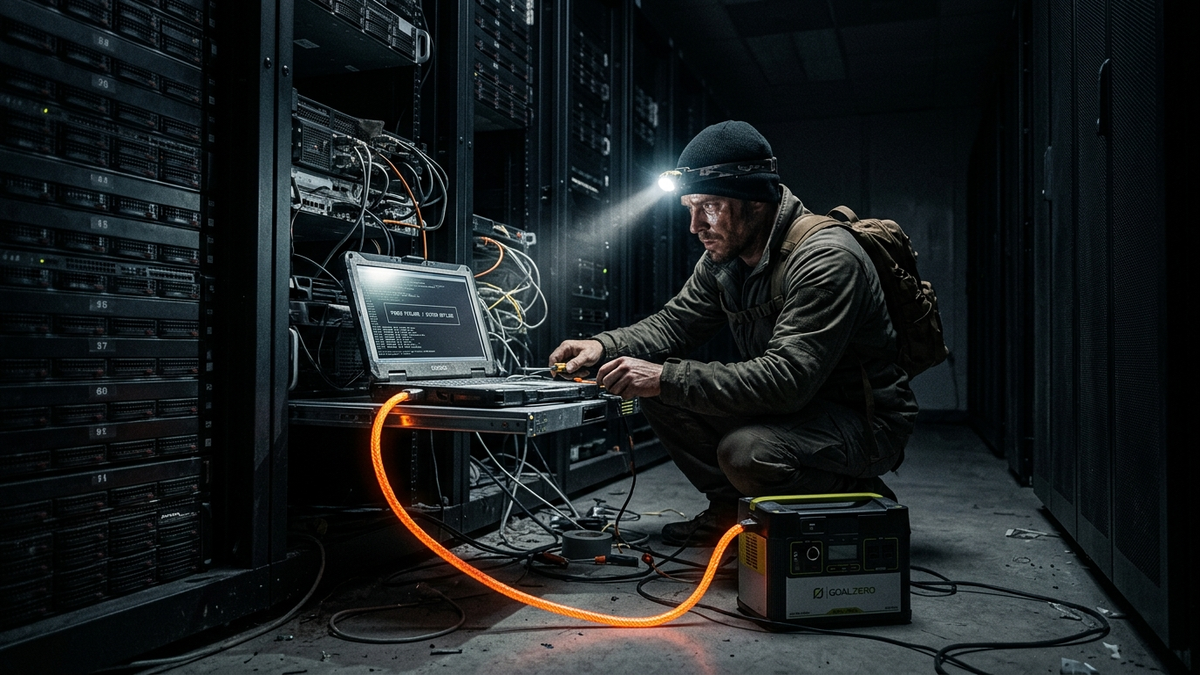
How to Survive a National Power Grid Cyber Attack in 2026: The SysAdmin's Blackout Bible
Quick Answer (TL;DR)
- Establish Power Independence: You need a personal power source, disconnected from the grid. A solar generator with panels is your best bet, sized to run critical devices like a fridge, comms, and lights.
- Build a Digital & Analog Archive: Your data in the cloud is gone. You need local, physical copies of everything on encrypted SSDs and USB drives, plus printed copies of essential documents stored in a waterproof container.
- Master Off-Grid Communications: Cell towers and the internet will be dead. You need redundant communication methods: short-range GMRS radios for local family, and long-range options like a licensed Ham radio or a satellite messenger for critical updates.
Introduction: This Isn't a Movie Script
Alright, let's cut the nonsense. I've spent 15 years watching state-sponsored actors and rogue groups poke and prod our critical infrastructure like it's a cheap toy. The power grid is the big one. It's a patchwork of ancient, insecure SCADA systems and modern, internet-connected hardware. It's not a matter of *if* it gets hit with a catastrophic attack, it's *when*. I'm putting my money on it happening by 2026.
When it goes down, it won't be a 24-hour inconvenience. We're talking weeks, maybe months. Your credit cards won't work. Gas pumps won't pump. Water treatment plants will fail. The internet will be a memory. This guide isn't about fear. It's about applying the same principles we use to create resilient IT systems—redundancy, backups, and failover plans—to your own life. This is your personal disaster recovery plan. Pay attention, because the people who think this is science fiction will be the first ones in trouble.
Section 1: The Brutal Reality of a Grid-Down Scenario
First, you need to understand what you're up against. A national power grid failure isn't just the lights going out. It's a cascading failure of every system that depends on electricity. Think of the grid as the master server for society; if it goes offline, all the services that depend on it crash simultaneously. The first 24 hours will be confusing, but after 72 hours, the reality will set in for everyone else, and things will get ugly fast. Your goal is to be self-sufficient long before that panic starts.
Let's talk specifics. The Supervisory Control and Data Acquisition (SCADA) systems that run our grid are notoriously insecure. Many were designed decades ago, before the internet was a public utility, and have been bolted onto modern networks with minimal security. An attacker doesn't need to blow up a transformer with a missile; they just need to find an exploit, gain access, and command the grid's own equipment to destroy itself by opening and closing breakers out of phase. This creates a cascading overload that physically melts hardware. That's not a software patch fix; that's years of replacing massive, custom-built equipment.
So, what does your world look like on Day 3? Your tap water might stop running because the municipal pumps have no power. Your toilets won't flush in a high-rise. The grocery store shelves will be empty, and their payment systems will be down anyway. ATMs are useless metal boxes. Your EV is a brick, and gas stations can't pump fuel. All logistics, from trucking to trains, will grind to a halt. The world will shrink to the distance you can walk. This isn't about surviving the dark; it's about surviving the complete collapse of modern convenience and supply chains. Your preparation needs to be based on this grim, but realistic, foundation.
Forget about the government swooping in to save you in the first week. Their priority will be securing critical infrastructure and dealing with mass-scale civil unrest. You are your own first responder. Every step you take in the next sections is about building a bubble of stability for you and your family in the middle of that chaos. The mindset is key: assume nothing will work and no one is coming to help. Plan accordingly.
Section 2: Phase Zero - Your Personal Power Grid
Everything starts with power. Without it, all your fancy tech is junk. Your goal is to create a small, independent, and sustainable power source that is completely isolated from the national grid. This is your Tier 1, mission-critical infrastructure. Forget those cheap, noisy gas generators for a minute. While they're okay as a last resort, they rely on a fuel supply that will vanish in 48 hours. They're loud, they attract unwanted attention, and they're a temporary fix for a long-term problem.
Your primary investment should be in a solar generator, which is really just a fancy name for a portable power station with a high-quality lithium battery (LiFePO4 is the best), a pure sine wave inverter, and a solar charge controller. Brands like Bluetti, EcoFlow, or Jackery are the big players here. You need to size it correctly. Don't just look at the battery capacity in watt-hours (Wh); you need to check the inverter's output in watts (W). The inverter determines what you can run simultaneously. A 2000W inverter can run a modern, energy-efficient refrigerator, while a 300W inverter can only handle charging phones and laptops.
Your minimum viable setup should be a power station with at least 1500Wh of capacity and a 2000W inverter, paired with 200-400 watts of portable solar panels. This will allow you to run the absolute essentials: a small fridge or freezer (to prevent food spoilage), charge your communication devices, run a few LED lights, and maybe a small medical device. You must test this setup *before* you need it. Know exactly how long it takes to recharge from the sun on a clear day and a cloudy day. Understand its limitations. You're not going to be running your air conditioning, but you'll be able to keep food cold and stay informed, which puts you ahead of 99% of the population.
💡 Expert IT Tip: Perform a power audit on your critical devices *now*. Use a simple Kill A Watt meter (they cost about $20) to measure the exact power consumption of your refrigerator, freezer, modem, and chargers. Don't trust the label. My "energy-efficient" fridge actually has a peak startup draw of nearly 700 watts. Knowing the true numbers will prevent you from buying an undersized, useless power station. Create a spreadsheet with "Device," "Running Watts," and "Startup Watts." This is your power budget, and it's non-negotiable.
Section 3: Fortifying Your Digital Citadel - Data Lockdown
In a grid-down scenario, the "cloud" evaporates. All your files in Google Drive, iCloud, and Dropbox are gone. Your bank account balance is an inaccessible number on a server you can't reach. Your digital life needs a physical home, and it needs to be in your possession. You are creating a local, air-gapped backup of your entire existence. We do this for mission-critical servers; you're now the server.
First, create a "Digital Go-Bag." This consists of at least two encrypted, high-capacity solid-state drives (SSDs). I recommend Samsung T7 Shield or SanDisk Extreme Pro drives. Why two? Redundancy. One is your primary, the other is a backup stored in a separate, safe location. On these drives, you will store:
- Vital Documents: Scans of passports, birth certificates, deeds, social security cards, insurance policies. Encrypt the folder containing these with something strong like VeraCrypt.
- Personal Data: A full export of your phone contacts, a complete backup of all family photos and videos, and any sentimental digital files.
- Knowledge Cache: This is critical. Download offline versions of Wikipedia, survival manuals (the US Army FM 21-76 is a classic), medical guides, repair manuals for your car and gear, and detailed local maps. You can use software like Kiwix to download and browse these offline.
Second, think about hardware. You need a low-power device to access this data. A modern, power-hungry gaming laptop is a terrible choice. A better option is something like a Microsoft Surface tablet or a MacBook Air with an M-series chip, known for their extreme power efficiency. You need to pre-load this device with all the necessary software: the aforementioned Kiwix, a password manager with a local database (like KeePassXC), and offline map software (like OsmAnd). Charge it, then power it down completely and store it in your go-bag.
Finally, consider the threat of an Electromagnetic Pulse (EMP), whether from a solar flare or a weapon. While a cyber attack is the more likely grid-killer, state actors often pair them. To protect your Digital Go-Bag, store the SSDs, your powered-down laptop, and other small electronics in a Faraday bag. These are metallic fabric bags that block electromagnetic radiation. Think of it as a firewall for radio waves. It's a cheap insurance policy that ensures your meticulously prepared data archive will actually be usable when you need it most.
Secure your digital wealth with the world's most trusted hardware wallets.
GET YOUR WALLET NOWSection 4: The Comms Blackout Plan - Speaking When No One Can Hear
When the grid fails, the modern communication network we take for granted will collapse within hours. Cell towers have battery backups, but those typically last 4-8 hours, not days or weeks. The fiber optic repeaters that form the internet's backbone also require power. Your smartphone will become a pocket calculator with a nice camera. Staying informed and connected to your immediate community will be a lifeline.
Your communication plan needs layers, just like a network security model.
- Layer 1 (Local/Intra-Family): Get a set of GMRS (General Mobile Radio Service) radios. They are more powerful than the cheap FRS walkie-talkies you see in department stores. GMRS requires a license in the US, but it's cheap ($35), there's no test, and it covers your entire immediate family for 10 years. With a good GMRS handheld, you can reliably communicate within a 1-5 mile radius in a town, and much further in open terrain. This is for coordinating with your spouse, kids, or a next-door neighbor.
- Layer 2 (Community/Regional): This is where Ham radio comes in. Getting your entry-level Technician license is not difficult; it requires passing a multiple-choice test. With a basic handheld Ham radio like a Yaesu or ICOM (avoid the cheap Baofengs if you can), you can hit local repeaters (some of which have robust emergency power) and talk to people across your city or county. This is how you'll get real, vetted information about what's happening, find resources, or call for help. It's the original social network, and it works when the internet doesn't.
- Layer 3 (Global/Emergency): For true, "I need to tell someone I'm alive" messaging, you need a satellite device. A Garmin inReach or a Zoleo allows you to send and receive short text messages via the Iridium satellite network, which is completely independent of terrestrial infrastructure. It's not for browsing the web; it's for sending a pre-written "All OK" message to a loved one in another state or for triggering an SOS in a dire medical emergency. The subscription fee is a small price to pay for a guaranteed link to the outside world.
💡 Expert IT Tip: Don't just buy a Ham radio; learn how to use it. Find your local ARES (Amateur Radio Emergency Service) group. These are the folks who train for this exact scenario. Attending their meetings is the fastest way to learn about programming your radio, understanding radio etiquette, and finding the key repeater frequencies in your area. They often have pre-made frequency lists you can program into your radio, which will save you critical time when things go sideways.
Section 5: The Analog Fallback: Prepping for Zero-Tech
As an IT professional, it's hard to admit, but we must plan for a scenario where all our carefully prepared tech fails. Batteries die, devices break, or an EMP could render everything useless. Your ultimate backup is analog. It's non-electronic, time-tested, and completely reliable. This is your system's failsafe, the equivalent of a cold-site backup that requires manual activation.
First, information. Your brain is your primary tool, but it needs data. Go to your local AAA or a good bookstore and buy detailed physical maps. You need a local city map with street names, a regional topographical map, and a state road atlas. Learn how to read them. Buy a good quality compass, like a Suunto or a Silva, and learn the basics of land navigation. Knowing how to get from Point A to Point B without Google Maps is a skill that has become dangerously rare. Print out hard copies of your most critical documents—the same ones on your encrypted SSD—and have them laminated or stored in a waterproof document bag.
Next, finance. Digital money will cease to exist. Credit cards, debit cards, Zelle, Venmo—all gone. You need cash, specifically small bills. No one will be able to make change for a $100 bill when their cash register is a dead box. A stash of ones, fives, and tens is essential for the initial days when some small-scale commerce might still be possible. Beyond that, you need to think about barter. What skills or goods do you have? A water filter, extra batteries, or the knowledge to fix a radio could be far more valuable than a stack of cash in a long-term crisis.
Finally, basic tools and skills. This is the hardware of your analog life. Have a well-stocked toolbox. Know how to shut off the water and gas to your house. Have a quality water filter (like a Sawyer Squeeze or a Lifestraw Family) and know how to use it. Have multiple ways to make fire. These skills are the foundational code of human survival. Your ability to solve physical problems will become just as important as your ability to troubleshoot a network. In a world without power, practicality is king.
Section 6: The Long Haul: Community as Your Network
Individual preparation will get you through the first week. Surviving for a month or more requires something else: a community. As sysadmins, we know that a single, isolated server is a point of failure. A distributed, resilient network is what survives. The same principle applies here. Your ultimate survival tool is a trusted network of people.
Start now. Get to know your neighbors. Don't be the weird "prepper" in the basement; be the helpful, skilled person on the block. Who has medical training? Who is a good mechanic? Who has a large garden? You have valuable IT and problem-solving skills. Offer to help your elderly neighbor set up their Wi-Fi or remove a virus from their computer. You're not just being nice; you're building social capital. These are the people you will rely on, and who will rely on you, when the normal systems of support are gone.
Establish a simple, non-verbal communication plan with your immediate neighbors. For example, a green flag or towel in a front window means "All okay here." A red one means "We need help." This is a low-tech, secure way to check on each other without drawing attention. In a crisis, your neighborhood becomes your LAN (Local Area Network). You need to know who is on it and how to communicate with them. Your GMRS radios are perfect for this, allowing you to coordinate without shouting across the street.
Think about skills as a form of currency. Your ability to set up a small solar power system or rig up a communication link will be incredibly valuable. You might trade a few hours of your expertise for food from a neighbor's garden or medical advice from a nurse down the street. This is the new economy. It's not about hoarding resources in a bunker; it's about becoming a valuable, indispensable node in a new, hyper-local community network. A person with skills and a willingness to help is far more secure than a person with a pile of supplies and no allies.
Conclusion
Look, this isn't about paranoia. It's about professional risk management applied to your life. We run drills, we create backups, and we build redundant systems for our companies because we know that failure is always a possibility. A national grid failure is the ultimate single point of failure for society. Ignoring it is professional malpractice on a personal level.
The steps I've outlined—power independence, data sovereignty, communication redundancy, and community building—are not extreme. They are a logical, scalable disaster recovery plan. Start small. Get a simple power station and a couple of radios. Print your documents. Talk to your neighbor. Each step you take makes you more resilient and less dependent on a fragile system. Don't be the person caught by surprise. Be the one who planned ahead. Be the sysadmin of your own survival.
Don't wait for the headlines. Our Private Telegram Channel delivers real-time AI security updates and digital wealth strategies before they go viral. Stay protected. Stay ahead.
⚡ JOIN THE 1% NOW🧰 Try Our Free Tools & Calculators
No sign-up required. Instantly check risks, analyze AI text, or calculate your digital finances.