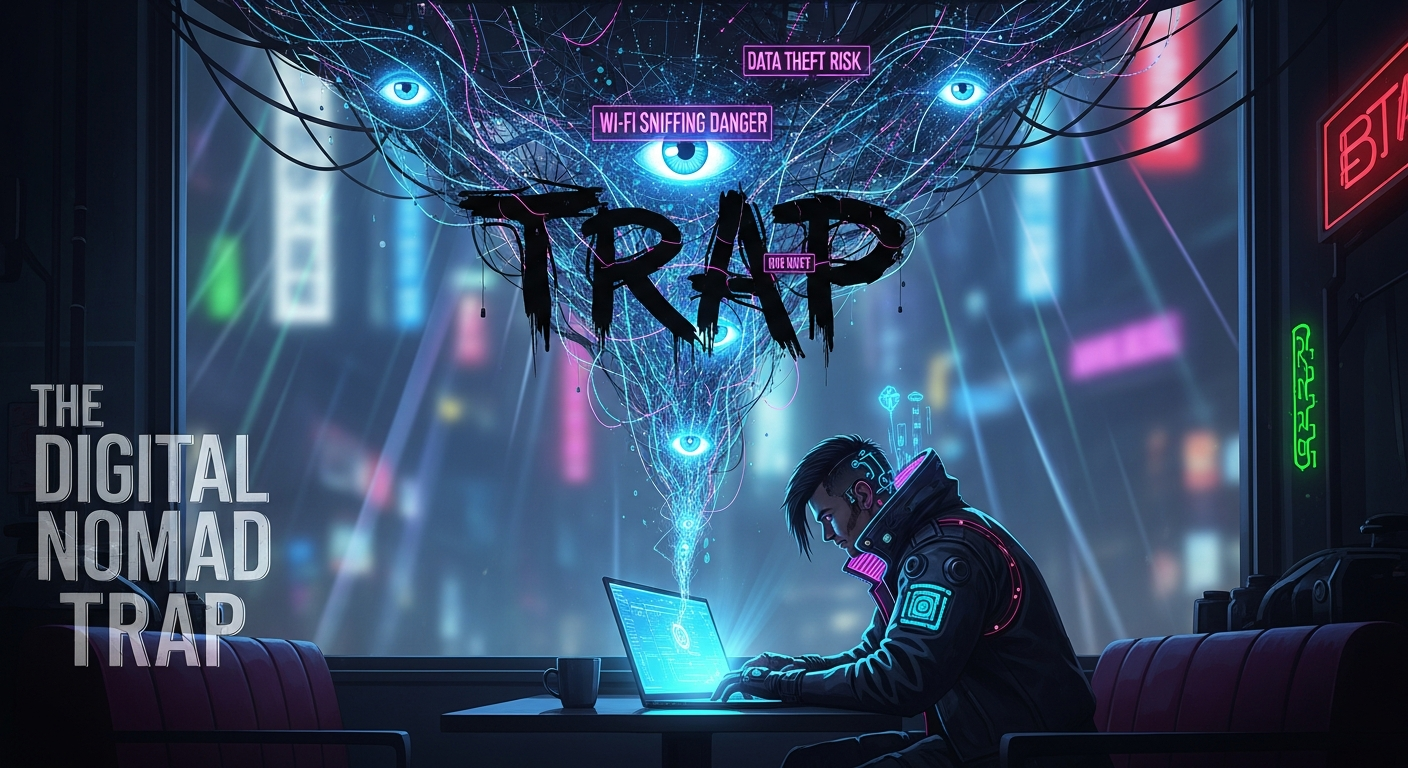
The "Digital Nomad" Trap: Why Remote Workers are the #1 Target for Wi-Fi Sniffing
Quick Answer (TL;DR)
- Digital nomads and remote workers heavily rely on public Wi-Fi, which is often unencrypted and easily monitored by cybercriminals using packet sniffing tools like Wireshark.
- Attackers create "Evil Twin" hotspots that mimic legitimate networks (e.g., "Airport_Free_WiFi"), tricking your devices into connecting and allowing them to intercept all your data, including passwords and financial details.
- Unlike office-based employees protected by corporate firewalls, remote workers lack a secure network perimeter, making their blend of personal and professional data an incredibly valuable and vulnerable target.
- The single most critical defense is a high-quality VPN (Virtual Private Network), which encrypts your entire internet connection, rendering your data unreadable to anyone snooping on the network.
Introduction
The image is seductive: a laptop open, a steaming cup of artisan coffee beside it, and a backdrop of a bustling Parisian café or a serene Balinese beach. This is the promise of the digital nomad life—a career untethered from the cubicle, a fusion of work and wanderlust. This lifestyle, once a niche pursuit, has exploded into a global movement, accelerated by a worldwide shift to remote work. But beneath this idyllic surface lies a dark and dangerous undercurrent, an unseen digital trap that ensnares thousands of unsuspecting professionals every day. The very freedom that defines the remote worker—the ability to connect from anywhere—is also their greatest vulnerability. Every airport lounge, hotel lobby, and neighborhood coffee shop they log into is a potential hunting ground for cybercriminals. These digital predators aren't looking for teenagers browsing social media; they're targeting high-value prey. They're targeting you, the remote worker, because you are the weakest link in the corporate security chain and a walking, talking treasure trove of sensitive data. This article pulls back the curtain on the number one threat facing the modern remote workforce: Wi-Fi sniffing, and explains why your convenient connectivity is a hacker's open invitation.
The Allure of the Open Network: A Digital Predator's Hunting Ground
To understand the danger, you must first understand the environment. Public Wi-Fi is, by its very nature, a paradox: it offers the gift of connection while simultaneously stripping away the armor of privacy. Think of an unencrypted public Wi-Fi network not as a private phone call, but as a crowded public square where you are forced to shout every piece of information you send and receive. Every email you compose, every password you type, every credit card number you enter is a broadcast that anyone in the vicinity with the right, easily accessible tools can "overhear." The data you transmit over the internet is broken down into small pieces called "packets." On an unsecured network, these packets travel "in the clear," meaning they are completely unencrypted and can be captured, reassembled, and read as plain text. A cybercriminal sitting in the corner of the same café doesn't need sophisticated government-grade technology to do this; they need a laptop, a compatible Wi-Fi adapter, and free, open-source software. They are essentially digital eavesdroppers, passively listening to everything you do online.
Many remote workers fall into a false sense of security when they connect to a network that requires a password, like those found in hotels or co-working spaces. They see the padlock symbol and assume their connection is private. This is a critical and common misunderstanding. While this password (known as a Pre-Shared Key or PSK) encrypts the traffic between your device and the router, every single person in that hotel or office who has the same password holds the key to decrypting it. Specialized tools can easily use this shared key to decrypt and view the traffic of any other user on the network. The password isn't for your personal security; it's simply a weak gate to keep non-customers out. It does absolutely nothing to protect you from other customers, one of whom could be the attacker.
The value of the data being transmitted in these environments is astronomical. For a digital nomad, this isn't just personal information. It's the lifeblood of their career and their employer's business. We're talking about login credentials to corporate cloud services (AWS, Google Cloud, Azure), access to proprietary company code on GitHub, sensitive client information in a CRM, financial reports, marketing strategies, and private conversations on Slack or Microsoft Teams. A single captured password can be the key that unlocks an entire corporate kingdom. For the cybercriminal, targeting a digital nomad isn't just about stealing one person's identity; it's a strategic move to breach a multi-million dollar company through its most exposed and vulnerable entry point. The cozy café, therefore, transforms from a pleasant workspace into a high-stakes arena where every click and keystroke is a potential liability.
The Anatomy of a Wi-Fi Sniffing Attack: Meet the 'Evil Twin'
While passive "sniffing" on an open network is dangerous, the most effective and insidious method used by attackers is a more active approach known as the "Man-in-the-Middle" (MITM) attack, most commonly executed via a malicious hotspot called an "Evil Twin." This attack is deviously simple to execute and devastatingly effective against the unsuspecting remote worker. It preys on the automatic, often mindless, way our devices seek out and connect to familiar Wi-Fi networks. The process is methodical and requires very little technical prowess on the part of the attacker, making it incredibly widespread.
Here is how the trap is set. First, the attacker arrives at a popular remote work location—an airport business lounge, a chain coffee shop, or a busy co-working space. They use a simple network scanning tool on their laptop or even a smartphone to identify the name (the SSID) of the legitimate public Wi-Fi network, for example, "Starbucks_Free_WiFi" or "Airport_Guest_Connect." Next, using a portable piece of hardware like a small Raspberry Pi or simply their laptop's wireless card configured in a specific mode, they create their own fraudulent Wi-Fi hotspot. They configure this malicious hotspot to broadcast the exact same name as the legitimate one. To complete the deception, they boost their hotspot's signal so that it is stronger than the real one. Your laptop, phone, and tablet are designed for convenience; they will automatically disconnect from a weaker signal and connect to the strongest available signal with a familiar name. Without any warning or notification, your device latches onto the attacker's Evil Twin.
From this moment on, the attacker is the "man in the middle." They have become your internet service provider. Every single packet of data leaving your device passes directly through their computer before it's forwarded to the real internet. And every packet returning to you is also routed through their machine. They now have complete control and visibility over your entire digital life. They can deploy packet sniffing software like Wireshark to capture, analyze, and save everything. But it gets worse. A sophisticated attacker will also employ a technique called "SSL Stripping." You might think you're safe because you see the "https" and the padlock icon in your browser. However, the attacker's Evil Twin can intercept your device's attempt to make a secure (HTTPS) connection to a website. It will then establish that secure connection on your behalf, while simultaneously serving your browser a non-secure (HTTP) version of the site. Your browser communicates in plain text with the attacker's machine, and the attacker's machine communicates securely with the destination website. You are none the wiser, and every piece of data you enter on that seemingly secure banking or email login page is captured in plain text.
Why Digital Nomads are the Perfect Victim: A Profile in Vulnerability
Cybercriminals operate like any rational economic actor: they seek the highest return on investment with the least amount of risk and effort. When viewed through this lens, the digital nomad and remote worker population emerges as the perfect, high-value target. It's a demographic that is uniquely concentrated, predictable, and fundamentally unprotected compared to its office-bound counterparts. This convergence of factors makes them not just a target, but the number one target for network-based attacks.
First and foremost is the value of the potential prize. The average digital nomad is not just a casual internet user; they are a professional handling sensitive information. They could be a software developer with access to source code and production servers, a financial consultant with client investment data, a marketing manager with unreleased campaign strategies, or an executive with access to the entire company's internal network. Breaching one remote worker's laptop is a far more lucrative proposition than hacking ten random café patrons browsing social media. For a hacker, this is the difference between robbing a pedestrian and robbing a bank courier; the nomad is carrying the keys to the vault.
Second, their behavior is incredibly predictable. Attackers know where to find them. They congregate in predictable "watering holes": co-working spaces in cities like Lisbon and Chiang Mai, specific coffee shop chains known for good Wi-Fi, and the business class lounges of international airports. An attacker doesn't have to cast a wide, random net. They can go to a single location and be virtually guaranteed to find dozens of high-value targets in one place, all connecting to the same vulnerable network. This concentration dramatically increases the efficiency and success rate of their attacks.
The most critical vulnerability, however, is the complete absence of a corporate security perimeter. In a traditional office environment, an employee is protected by layers of enterprise-grade security: corporate firewalls, intrusion detection systems, managed networks, and a dedicated IT security team actively monitoring for threats. The office is a digital fortress. The digital nomad, in contrast, is a lone soldier operating deep in enemy territory with no backup. Their "perimeter" is the flimsy, often non-existent security of whatever public network they can find. They are their own IT department, often without the training or tools to properly defend themselves against a determined adversary.
Secure your digital wealth with the world's most trusted hardware wallets.
GET YOUR WALLET NOWFinally, the blurring of personal and work devices creates a massive attack surface. The same laptop used to access the company's most sensitive servers in the morning is used to download questionable software or stream movies from pirated sites at night. A personal phone with dozens of insecure apps and permissions connects to the same vulnerable Wi-Fi as the work laptop. This "bring your own device" (BYOD) culture, when extended to the global, unsecured stage of nomadic life, means a compromise on any front—personal or professional—can lead to a catastrophic breach of the other. This combination of high value, predictability, and a near-total lack of a security backstop makes the digital nomad the ideal target for Wi-Fi sniffing attacks.
The Arsenal of Defense: Essential Tools and Practices for the Modern Remote Worker
The threat landscape for a digital nomad is hostile, but it is not hopeless. Surviving and thriving in this environment requires a deliberate shift in mindset: you must assume every network you connect to is compromised and actively build your own personal security perimeter. This isn't about paranoia; it's about professionalism. Fortunately, a powerful arsenal of tools and practices is readily available to fortify your digital life. Adopting these measures is not optional; it is a fundamental requirement for any responsible remote worker.
The single most important tool in your defensive arsenal is a Virtual Private Network (VPN). A reputable, paid VPN is non-negotiable. A VPN creates a heavily encrypted, private tunnel between your device and a secure server operated by the VPN provider. All your internet traffic—from your browser, email client, Slack app, and everything else—is routed through this tunnel. To a Wi-Fi sniffer on the local network, even one running an Evil Twin attack, your data is completely unreadable. All they can capture is a stream of scrambled, encrypted gibberish. They can see that you are connected, but they cannot see what you are doing or what data you are sending. When choosing a VPN, look for critical features: a strict no-logs policy (ensuring they don't store your activity), AES-256 encryption (the industry standard), and a kill switch, which automatically cuts your internet connection if the VPN drops, preventing any data from accidentally leaking onto the unsecured network.
Beyond the VPN, several other layers of security are essential. Always ensure your connection to websites is secure by looking for the HTTPS protocol and the padlock icon in your browser's address bar. This encrypts the connection between your browser and the website's server. To enforce this, use a browser extension like "HTTPS Everywhere," which forces your browser to use a secure connection whenever one is available. For times when you need a quick, secure connection and don't trust the local Wi-Fi, your smartphone is your best friend. Using your phone as a personal mobile hotspot (tethering) creates a direct, private network between your laptop and the cellular network, bypassing the public Wi-Fi entirely. While it consumes mobile data, it is vastly more secure for sensitive tasks.
Finally, fundamental cyber hygiene is critical. Ensure your device's built-in firewall is always enabled. This acts as a barrier, monitoring incoming and outgoing network traffic and blocking malicious connections. Install a reputable antivirus and anti-malware suite and keep it updated. Enable Two-Factor Authentication (2FA) on every single account that offers it—email, banking, social media, and especially work accounts. With 2FA, even if an attacker manages to steal your password, they cannot access your account without the second factor (typically a code from your phone). Lastly, be relentless about installing software updates for your operating system, browser, and all applications. These updates frequently contain patches for critical security vulnerabilities that attackers actively exploit. By layering these tools and practices, you transform yourself from a soft target into a hardened, resilient digital professional.
Beyond the Cafe: Other Digital Traps Nomads Fall Into
While Wi-Fi sniffing in public spaces is the most prevalent network-based threat, the digital nomad's life is fraught with other dangers that extend beyond the coffee shop. A holistic approach to security requires acknowledging these varied and interconnected risks. The transient nature of the lifestyle, involving constant movement between different accommodations, cities, and countries, opens up unique avenues for attack that a stationary worker would never encounter. A compromised laptop is a compromised laptop, whether the breach occurred through a malicious network or a moment of physical carelessness.
The most immediate and low-tech threat is physical device security. The casual, trusting atmosphere of a co-working space or cafe can breed complacency. Stepping away from your unlocked laptop for "just a minute" to grab a coffee or take a phone call is all an opportunistic attacker needs. In less than 30 seconds, they can insert a malicious USB device, such as a "USB Rubber Ducky," which impersonates a keyboard and can inject malware, install a keylogger, or exfiltrate sensitive files. Even more simply, the risk of outright theft is significantly higher for someone constantly on the move. A stolen laptop isn't just a loss of hardware; it's a potential breach of your entire personal and professional life if the data isn't properly encrypted.
Phishing and social engineering scams are also particularly effective against nomads. The context of constant travel provides fertile ground for believable pretexts. An email that appears to be from Airbnb requesting you to re-enter your payment details, a fake flight cancellation notice with a malicious link, or a fraudulent login page for a hotel's Wi-Fi network can all seem perfectly legitimate to someone juggling bookings and itineraries. Because nomads are constantly interacting with new service providers, they are more conditioned to receive and act on such communications, lowering their natural suspicion compared to someone in a stable, predictable routine.
The security of your accommodation's network is another major blind spot. The Wi-Fi in your Airbnb or short-term rental is not inherently trustworthy. The router could be poorly configured with a default admin password, making it easy for anyone nearby to take control of it. A malicious host or even a previous guest could have tampered with the device, installing custom firmware to monitor all traffic passing through it. You must treat your rental's Wi-Fi with the same suspicion as a public cafe's network and use a VPN without exception. Furthermore, be wary of any "smart" devices in a rental, such as cameras or voice assistants, which could potentially be used for eavesdropping.
Conclusion
The digital nomad lifestyle represents the pinnacle of modern professional freedom, offering unparalleled opportunities for growth, experience, and work-life integration. However, this freedom is not free. It comes with a non-negotiable price: absolute personal responsibility for one's own digital security. The idyllic image of working from anywhere masks the stark reality that "anywhere" is often a hostile digital environment, with unseen predators actively hunting for valuable data. The convenience of public Wi-Fi has become a trap, luring remote workers into a false sense of security while exposing them, their clients, and their employers to catastrophic risk. The threat of Wi-Fi sniffing, particularly through insidious "Evil Twin" attacks, is not a hypothetical or distant danger; it is an active, pervasive, and immediate reality in every café, airport, and hotel lobby across the globe. To ignore this threat is to be willfully negligent. The modern remote worker must evolve, adopting a security-first mindset and building a personal fortress of defense through tools like VPNs, vigilant practices like using mobile hotspots, and unwavering cyber hygiene. The future of work may be remote, but its survival depends on being secure.
Don't wait for the headlines. Our Private Telegram Channel delivers real-time AI security updates and digital wealth strategies before they go viral. Stay protected. Stay ahead.
⚡ JOIN THE 1% NOW🧰 Try Our Free Tools & Calculators
No sign-up required. Instantly check risks, analyze AI text, or calculate your digital finances.