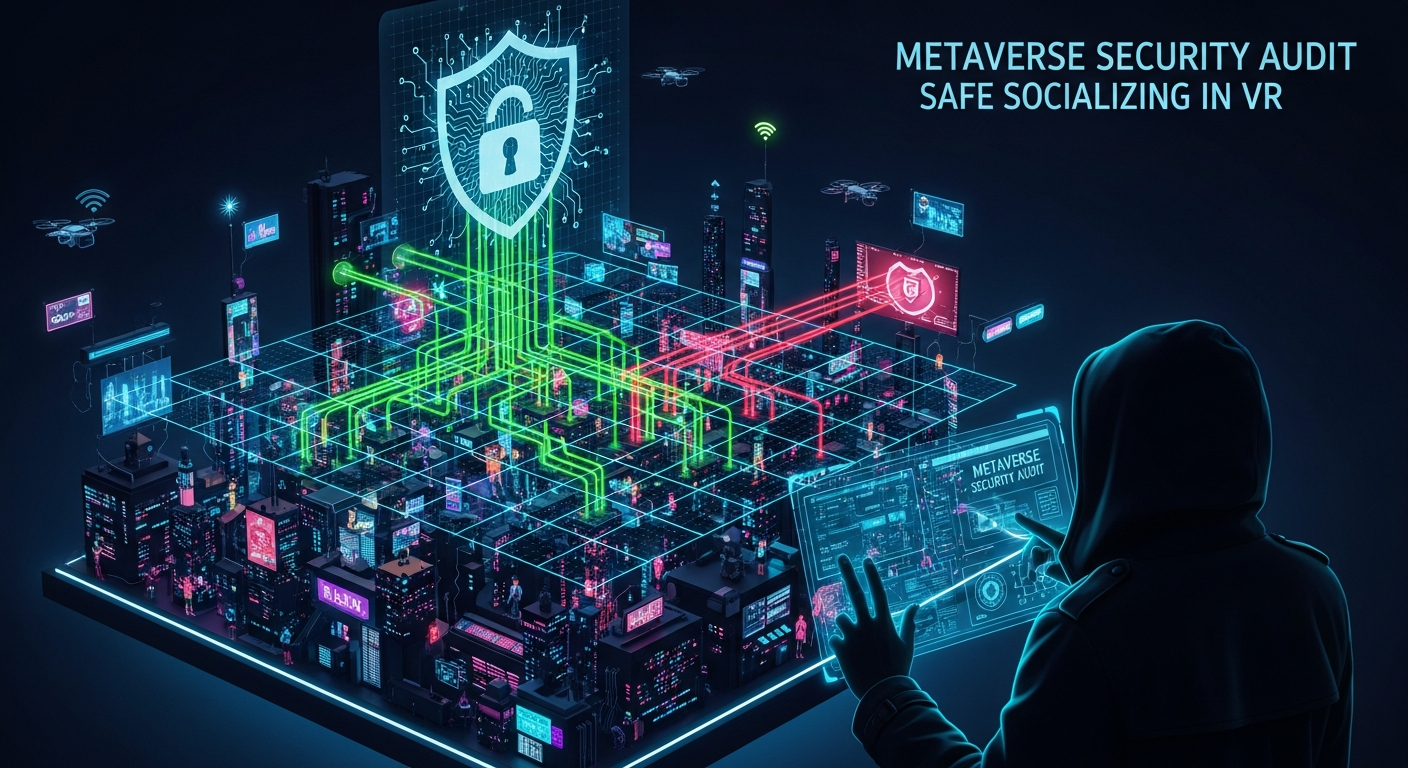
The Metaverse Security Audit: Safe Socializing in Virtual Reality
Quick Answer (TL;DR)
- A Metaverse Security Audit is crucial for identifying vulnerabilities across virtual platforms, ensuring user safety and asset integrity.
- Key audit areas include smart contract security, decentralized identity management, data privacy protocols, and virtual asset protection.
- Proactive audits help mitigate risks like identity theft, financial fraud, virtual property loss, and data breaches in immersive environments.
- Essential tools for auditors range from blockchain analytics platforms to AI-driven threat detection systems and specialized penetration testing frameworks.
- Both platform developers and individual users share responsibility, with audits forming the bedrock for trustworthy virtual experiences and secure interactions.
The metaverse, an emergent digital frontier promising immersive experiences, persistent virtual worlds, and entirely new economies, stands on the cusp of redefining human interaction. From virtual concerts and digital marketplaces to collaborative workspaces and social hubs, its potential is boundless. However, with this unparalleled promise comes an equally unprecedented set of security challenges. As we increasingly merge our digital and physical identities, transact with real-world value, and build communities in virtual spaces, the imperative for robust security measures becomes paramount. The concept of "safe socializing" in these nascent virtual realities is not merely a desirable feature but a fundamental requirement for widespread adoption and sustained trust. Without a proactive and comprehensive approach to security, the metaverse risks becoming a fertile ground for novel forms of cybercrime, privacy invasions, and systemic vulnerabilities that could erode user confidence and hinder its evolution. This article delves into the critical necessity of metaverse security audits, exploring the complex threat landscape, the meticulous processes involved, the technological solutions available, and the collective responsibility required to safeguard our virtual future.
Understanding the Metaverse Threat Landscape
The metaverse, by its very definition, is a complex tapestry woven from disparate technologies: blockchain, artificial intelligence, virtual and augmented reality, 5G connectivity, and sophisticated rendering engines. This intricate technological stack, while enabling incredible experiences, simultaneously introduces a multifaceted and evolving threat landscape far more intricate than traditional internet security paradigms. Unlike a static website or a single application, the metaverse is a persistent, interconnected, and often decentralized ecosystem, making it a prime target for malicious actors seeking new avenues for exploitation.
One of the most immediate and pressing concerns is identity theft and impersonation. In a virtual world where avatars represent users, the ability to convincingly mimic another user, especially one with significant virtual assets or social standing, can lead to severe consequences. Imagine a scenario where a high-value NFT owner's avatar is compromised, and their virtual property is fraudulently transferred, or their reputation is tarnished by malicious actions performed in their name. The decentralized nature of many metaverse platforms, while offering autonomy, also presents challenges for identity verification and recovery, making it harder to establish definitive ownership or authorship in the event of a breach. Traditional authentication methods may prove insufficient in a world where biometric data might be collected by VR headsets, creating new vectors for privacy invasion.
Another significant threat lies in financial fraud and virtual asset theft. The metaverse is rapidly becoming a vibrant economy, fueled by cryptocurrencies, NFTs, and other digital assets. These assets represent real-world value, making them irresistible targets. Vulnerabilities in smart contracts underpinning NFTs or virtual land sales, weaknesses in integrated cryptocurrency wallets, or sophisticated phishing schemes targeting metaverse users can result in irreversible financial losses. The immutable nature of blockchain transactions, while a strength for transparency, means that once a fraudulent transaction occurs, reversal is often impossible, underscoring the need for ironclad security at every transactional touchpoint. Furthermore, the burgeoning market for virtual goods creates opportunities for counterfeiting and intellectual property infringement, where unique digital creations can be replicated and sold without authorization, undermining creators' livelihoods and the integrity of the digital economy.
Beyond financial and identity-based crimes, the metaverse is also susceptible to unique forms of social engineering and harassment. The immersive nature of VR can amplify the psychological impact of cyberbullying, harassment, and even virtual assault. Malicious actors could exploit vulnerabilities in proximity chat, avatar interaction mechanics, or content moderation systems to create hostile environments. Data breaches involving personal communications, avatar preferences, or behavioral data collected within virtual worlds could lead to highly targeted attacks, compromising user privacy and psychological well-being. Moreover, the integration of AI-powered NPCs (non-player characters) and generative content introduces risks of algorithmic bias, manipulation, or the creation of harmful or inappropriate content that could be difficult to detect and moderate at scale. The interconnectedness also means that a vulnerability in one metaverse platform could potentially be leveraged to impact users or assets across multiple interconnected virtual worlds, creating a cascading effect of security incidents.
Finally, there are systemic threats related to platform integrity and infrastructure vulnerabilities. Distributed Denial of Service (DDoS) attacks could render entire virtual worlds inaccessible, disrupting economies and social interactions. Exploits in the underlying blockchain infrastructure, bugs in core metaverse protocols, or weaknesses in the cloud services hosting these virtual environments could have catastrophic consequences. As the metaverse evolves, so too will the sophistication of these threats, requiring continuous vigilance, adaptive security measures, and a deep understanding of the interwoven technological dependencies that define this new digital frontier. The sheer scale and real-time interaction demands of the metaverse mean that traditional security responses might be too slow, emphasizing the need for automated, AI-driven threat detection and rapid incident response capabilities. The absence of a central authority in many decentralized metaverses also complicates law enforcement and dispute resolution, placing a greater burden on built-in security mechanisms and community governance.
The Anatomy of a Metaverse Security Audit
A metaverse security audit is not a monolithic process but rather a meticulously structured examination, designed to scrutinize every layer of a virtual environment's technical and operational framework. It goes far beyond typical web application penetration testing, diving deep into the unique architectural complexities introduced by blockchain, VR/AR, and decentralized systems. The overarching goal is to identify, assess, and mitigate vulnerabilities before they can be exploited by malicious actors, thereby ensuring the integrity, confidentiality, and availability of the metaverse platform and its users' assets and data.
The initial phase of any comprehensive audit involves a thorough scoping and discovery process. This requires understanding the specific metaverse platform's architecture, its underlying technologies (e.g., Ethereum, Polygon, custom blockchain), the types of assets it hosts (NFTs, fungible tokens, virtual land), its user authentication mechanisms, and its integration points with external services. Auditors will map out the various components, including smart contracts, API endpoints, backend databases, client-side applications (VR headsets, desktop clients), and network infrastructure. This foundational understanding allows auditors to tailor their approach, focusing on the most critical and complex areas specific to that particular metaverse implementation, rather than applying a generic checklist. Identifying the potential blast radius of a successful attack is crucial during this phase, helping prioritize remediation efforts.
One of the most critical components of a metaverse security audit, especially for platforms built on Web3 principles, is smart contract auditing. Smart contracts are the self-executing agreements that govern transactions, asset ownership, and logical operations within many decentralized metaverses. Vulnerabilities in these contracts, such as reentrancy attacks, integer overflows, denial-of-service vectors, or incorrect access controls, can lead to catastrophic losses of funds or assets. Auditors utilize specialized tools and manual code review to meticulously examine Solidity, Rust, or other smart contract languages for known patterns of vulnerabilities, logical flaws, and adherence to best practices. This often involves static analysis (examining code without executing it), dynamic analysis (testing code during execution), and formal verification (mathematically proving the correctness of the contract's logic). Given the immutability of deployed smart contracts, pre-deployment audits are absolutely essential, as fixing bugs post-deployment can be incredibly complex or even impossible, often requiring costly migrations or leaving users exposed.
Beyond smart contracts, the audit extends to the API and backend infrastructure. Metaverse platforms rely heavily on APIs for communication between client applications, databases, and blockchain nodes. Auditors will perform penetration testing on these APIs, looking for common web vulnerabilities like injection flaws (SQL, NoSQL, command), broken authentication and authorization, insecure deserialization, and misconfigurations. They also assess the security of backend servers, databases, and cloud environments where critical data or computational processes reside. This includes reviewing network configurations, access controls, logging mechanisms, and patch management processes. The interconnected nature of metaverse components means that a weak link in a seemingly peripheral API could provide an entry point to compromise more critical systems, emphasizing the need for a holistic approach.
User authentication, authorization, and session management are also subjected to rigorous scrutiny. How do users log in? Is multi-factor authentication (MFA) supported and enforced? How are user permissions managed within the virtual world? Can one user impersonate another or gain unauthorized access to restricted areas or functionalities? Auditors will test for weak password policies, session hijacking vulnerabilities, and flaws in decentralized identity solutions like DID (Decentralized Identifiers) systems. The security of private keys and wallet integration, which often serve as the primary identity for Web3 users, is paramount. Furthermore, the audit examines data privacy controls, ensuring that personal identifiable information (PII) and behavioral data collected within the metaverse are handled in compliance with regulations like GDPR or CCPA, with appropriate encryption, access controls, and consent mechanisms in place. The audit will also consider the unique challenges of data privacy in immersive environments, where biometric data or real-time location data might be more readily available, requiring enhanced safeguards. Finally, an effective audit also includes reviewing the platform's incident response plan and its ability to detect, contain, and recover from security breaches, ensuring that preventative measures are complemented by robust reactive capabilities.
Key Pillars of Metaverse Security: Identity, Privacy, and Asset Protection
The successful and secure evolution of the metaverse hinges on three fundamental pillars: robust identity management, uncompromised data privacy, and impregnable asset protection. These are not merely features but foundational requirements that dictate user trust, regulatory compliance, and the overall stability of virtual economies. Neglecting any one of these pillars risks undermining the entire metaverse ecosystem, turning a promised utopia into a digital minefield.
Identity Management in the Metaverse: Traditional online identity systems, often centralized and prone to single points of failure, are ill-suited for the decentralized, interoperable vision of the metaverse. Here, the concept of a decentralized identity (DID) takes center stage. DIDs aim to give users sovereign control over their digital identities, allowing them to present verifiable credentials (e.g., age, qualifications, ownership of assets) without relying on a central authority. A secure metaverse must implement robust DID frameworks that allow users to create, own, and manage their identifiers without revealing unnecessary personal information. This involves cryptographic methods for identity verification, self-sovereign identity wallets, and secure protocols for credential issuance and presentation. An audit in this domain would meticulously examine the cryptographic primitives used, the integrity of the DID resolution mechanisms, the resistance to Sybil attacks, and the user experience for managing these complex identities. The goal is to prevent impersonation, ensure accountability for actions within the metaverse, and provide users with the tools to selectively disclose information, thereby enhancing both security and privacy. The audit also needs to consider the intertwining of on-chain and off-chain identity components, ensuring consistency and security across both domains. This includes evaluating how unique avatars are linked to underlying cryptographic identities and how reputation systems are built upon these verifiable identities, safeguarding against manipulation and fraud.
Data Privacy Protocols and User Control: The immersive nature of the metaverse means that platforms will likely collect vast amounts of data – from user interactions, movements, and preferences to potentially biometric data from VR/AR devices. Protecting this data is not just a matter of compliance with regulations like GDPR or CCPA, but a critical ethical imperative. A secure metaverse must implement comprehensive data privacy protocols that prioritize user control and transparency. This includes strong encryption for data at rest and in transit, anonymization and pseudonymization techniques where feasible, and granular consent mechanisms that allow users to dictate what data is collected, how it's used, and with whom it's shared. Auditors will scrutinize data handling policies, encryption standards, access control lists for sensitive data, and the effectiveness of privacy-enhancing technologies (PETs). They will also assess the potential for data leakage through third-party integrations, ensuring that every connected service adheres to the same high privacy standards. The audit will also evaluate the platform's ability to handle data deletion requests effectively and to provide users with clear, understandable privacy dashboards. Special attention must be paid to real-time data streams generated by VR hardware, such as gaze tracking, hand movements, and even physiological responses, ensuring these highly sensitive data points are protected with the utmost rigor and used only with explicit, informed consent. Any aggregation or analysis of this data must be conducted with privacy-preserving techniques to prevent re-identification.
Protect your identity and browse privately with Surfshark One - the all-in-one security suite.
GET 60% OFF SURFSHARK NOWVirtual Asset Protection and Economic Security: The metaverse is rapidly becoming a significant economic engine, with billions of dollars worth of NFTs, fungible tokens, and virtual land changing hands. Protecting these virtual assets from theft, fraud, and manipulation is foundational to the metaverse's economic stability and user adoption. This pillar encompasses the security of smart contracts governing asset creation and transfer, the robustness of integrated cryptocurrency wallets, and the integrity of marketplace mechanisms. Auditors will perform in-depth reviews of all smart contracts related to asset minting, trading, staking, and lending, looking for vulnerabilities that could lead to asset loss or unauthorized access. They will also assess the security of key management practices, multisignature wallet implementations, and cold storage solutions for high-value assets. Furthermore, the audit will examine the economic models themselves for potential exploits, such as flash loan attacks, oracle manipulation, or vulnerabilities that could lead to hyperinflation or deflation of virtual currencies. Ensuring the provenance and authenticity of NFTs, through secure minting processes and verifiable on-chain records, is also crucial to prevent counterfeiting and establish trust in digital ownership. This includes evaluating the metadata integrity and the resilience of the underlying storage solutions (e.g., IPFS) where the actual digital content of NFTs might reside, ensuring it cannot be tampered with or disappear. Ultimately, robust asset protection builds confidence, encouraging more users and investors to participate in the metaverse economy, knowing their digital property is as secure as their physical one.
Proactive Measures for Developers and Platform Owners
For the metaverse to truly flourish and achieve its immense potential, security cannot be an afterthought; it must be ingrained into its very DNA. Developers and platform owners bear the primary responsibility for building and maintaining secure virtual environments. This requires a proactive, "security-by-design" approach that integrates robust security practices at every stage of development, from initial concept to ongoing operations. Waiting for vulnerabilities to appear before addressing them is a recipe for disaster in a rapidly evolving and high-value ecosystem like the metaverse.
The cornerstone of proactive security is adopting a Security-by-Design and Privacy-by-Design (SbD/PbD) philosophy. This means that security and privacy considerations are not bolted on at the end of the development cycle but are fundamental requirements baked into the architecture, design, and implementation of every component. For metaverse platforms, this translates to designing smart contracts with formal verification in mind, building authentication systems that inherently support decentralized identities and multi-factor authentication, and architecting data storage solutions with encryption and granular access controls from day one. It involves conducting threat modeling exercises early in the design phase to identify potential attack vectors and designing countermeasures before any code is written. Developers should prioritize secure coding practices, utilizing frameworks and libraries known for their security, and avoiding common pitfalls that lead to vulnerabilities. This also extends to the user experience, ensuring that privacy settings are clear, easily accessible, and set to the most private defaults. By integrating security and privacy from the ground up, platforms can significantly reduce their attack surface and build a more resilient foundation for their virtual worlds.
Regular and comprehensive penetration testing is another non-negotiable proactive measure. Unlike a single audit, penetration testing involves simulating real-world attacks to identify exploitable vulnerabilities in the live system or a production-like environment. For a metaverse, this means testing not just web APIs and backend servers, but also the client-side VR/AR applications, the underlying blockchain infrastructure, smart contract interactions, and the interoperability mechanisms between different virtual spaces. Pen testers would attempt to exploit authentication flaws, bypass authorization controls, inject malicious code into smart contracts, manipulate virtual assets, and test the resilience against denial-of-service attacks. These tests should be conducted by independent, reputable security firms to ensure an unbiased and thorough assessment. The findings from penetration tests provide actionable insights, allowing developers to patch vulnerabilities before they are discovered and exploited by malicious actors. Furthermore, repeated penetration tests are essential as the metaverse evolves, new features are added, and new attack techniques emerge, ensuring continuous vigilance against novel threats.
Establishing a robust Bug Bounty Program is an excellent way to leverage the collective intelligence of the global cybersecurity community. By offering financial rewards to ethical hackers for identifying and responsibly disclosing vulnerabilities, platform owners can significantly augment their internal security efforts. A well-structured bug bounty program encourages a continuous stream of vulnerability reports, often uncovering obscure or complex flaws that might be missed by automated tools or internal audits. For metaverse platforms, this is particularly valuable given the novelty and complexity of the technology stack. The program should clearly define scope, reward tiers, and responsible disclosure guidelines. It not only helps identify vulnerabilities but also fosters a positive relationship with the security community, demonstrating a commitment to security and transparency. The constant external scrutiny provided by a bug bounty program acts as a dynamic defense mechanism, adapting to new threats as they appear and providing real-time feedback on the platform's security posture.
Finally, a well-defined and frequently tested Incident Response Plan (IRP) is absolutely critical. Despite the best proactive measures, breaches can and sometimes will occur. An effective IRP outlines the procedures for detecting, containing, eradicating, recovering from, and learning from security incidents. For metaverse platforms, this involves having mechanisms for real-time threat detection (e.g., anomaly detection, AI-driven monitoring), clear communication protocols for informing affected users and stakeholders, forensic capabilities to investigate the root cause of a breach, and robust backup and recovery strategies for virtual assets and user data. The plan should also address the unique challenges of responding to incidents in a decentralized environment, including coordination with blockchain validators or community governance bodies. Regular drills and simulations of various incident scenarios help ensure that the security team is prepared to act swiftly and decisively when a real threat materializes, minimizing damage and restoring trust. Proactive measures, coupled with a strong incident response capability, create a comprehensive security posture that is essential for building a safe and sustainable metaverse. This includes establishing clear lines of communication with law enforcement and regulatory bodies, particularly when incidents involve financial fraud or widespread data compromise, ensuring that legal and ethical obligations are met even in the face of a crisis.
Essential Tools and Solutions for Metaverse Security Audits
Conducting a comprehensive metaverse security audit demands a specialized toolkit that extends beyond traditional cybersecurity instruments. The unique blend of blockchain, virtual reality, and distributed systems requires solutions tailored to analyze smart contracts, secure decentralized identities, monitor real-time virtual interactions, and protect complex digital assets. Auditors must leverage a combination of automated tools, manual expertise, and cutting-edge technologies to effectively uncover vulnerabilities across this multifaceted landscape.
At the forefront for any blockchain-integrated metaverse are Smart Contract Auditing Tools and Platforms. These are indispensable for identifying vulnerabilities in the foundational code that governs virtual assets, transactions, and logic. Tools like Mythril, Slither, and Truffle Security perform static analysis, automatically scanning Solidity or other smart contract code for known security patterns such as reentrancy, integer overflows, access control issues, and denial-of-service vectors. Beyond static analysis, dynamic analysis tools allow auditors to test contracts in a simulated environment, observing their behavior under various conditions. Furthermore, platforms like CertiK, PeckShield, and Quantstamp offer comprehensive smart contract auditing services, combining automated tools with expert manual review and formal verification techniques to mathematically prove the correctness of contract logic. These services are critical pre-deployment, as immutable smart contracts make post-deployment bug fixes incredibly challenging or impossible. They also often provide real-time monitoring of deployed contracts for suspicious activities, adding a layer of continuous protection.
For monitoring the underlying blockchain and identifying suspicious transactions, Blockchain Analytics and Forensics Platforms are paramount. Tools such as Chainalysis, Elliptic, and Etherscan (for Ethereum-based metaverses) allow auditors to trace transaction flows, identify addresses associated with illicit activities, and analyze the movement of virtual assets. These platforms can detect patterns indicative of money laundering, fraud, or even state-sponsored attacks. They provide crucial visibility into the on-chain activities that underpin metaverse economies, helping to identify anomalous behavior that might signal a security breach or economic manipulation. Forensic capabilities are also vital for post-incident investigations, enabling auditors to reconstruct events and identify the source of an attack. The ability to visualize complex transaction graphs and identify clusters of addresses is invaluable for understanding the scope and impact of a security incident and for aiding in the recovery of stolen assets or the identification of perpetrators.
Securing user identity and access within the metaverse requires specialized Decentralized Identity (DID) and Wallet Security Solutions. As users move towards self-sovereign identities, auditing the cryptographic mechanisms, key management practices, and credential verification processes becomes critical. Solutions that integrate hardware security modules (HSMs) for private key storage, multi-signature wallet implementations, and robust authentication protocols (e.g., WebAuthn adapted for metaverse contexts) are essential. Audit tools must assess the resilience of these systems against phishing, key compromise, and impersonation attempts. Furthermore, the security of integrated cryptocurrency wallets, whether browser-based or hardware-based, is a major focus, ensuring that they are protected against malware and unauthorized access. Solutions that offer secure enclave technology for private keys within VR headsets or client applications are also becoming increasingly important, providing a hardware-level of protection against software exploits. The audit also extends to assessing the interoperability of these identity solutions across different metaverse platforms, ensuring that security standards are maintained even when users traverse virtual boundaries.
The real-time, immersive nature of the metaverse also necessitates AI-driven Threat Detection and Behavioral Analytics Systems. Traditional signature-based intrusion detection systems are often insufficient for identifying novel attacks in dynamic virtual environments. AI and machine learning algorithms can analyze vast amounts of user interaction data, network traffic, and avatar behavior patterns to detect anomalies indicative of malicious activity – such as unusual movement patterns, rapid asset transfers, or suspicious communication. These systems can identify bots, detect coordinated attacks, and flag potential social engineering attempts that might bypass traditional security controls. For example, an AI could detect an avatar attempting to access restricted areas or engaging in rapid, unauthorized transactions, triggering an alert. Solutions that leverage machine learning to profile "normal" metaverse behavior can quickly pinpoint deviations, providing early warnings of potential threats. This includes monitoring for virtual world exploits, griefing, and other forms of in-game abuse that can significantly degrade the user experience and security. The ability of AI to process and interpret complex, real-time data streams makes it an indispensable tool for maintaining continuous security posture in the ever-evolving metaverse, predicting and preventing attacks before they cause widespread damage. These systems can also be trained to identify deepfakes or AI-generated malicious content, which pose a growing threat in immersive virtual environments, ensuring that users interact with authentic and safe digital entities.
User Empowerment: Navigating the Metaverse Safely
While developers and platform owners bear the primary responsibility for building a secure metaverse, individual users play an equally critical role in safeguarding their own experiences and contributing to the overall security of the ecosystem. Just as in the physical world, personal vigilance and informed decision-making are paramount when navigating the complexities of virtual reality. Empowering users... and implement these strategies to ensure long-term success.
Conclusion
In summary, staying ahead of these trends is the key to business longevity and security. By following this guide, you maximize your growth and ensure a stable digital future.
Don't wait for the headlines. Our Private Telegram Channel delivers real-time AI security updates and digital wealth strategies before they go viral. Stay protected. Stay ahead.
⚡ JOIN THE 1% NOW🧰 Try Our Free Tools & Calculators
No sign-up required. Instantly check risks, analyze AI text, or calculate your digital finances.