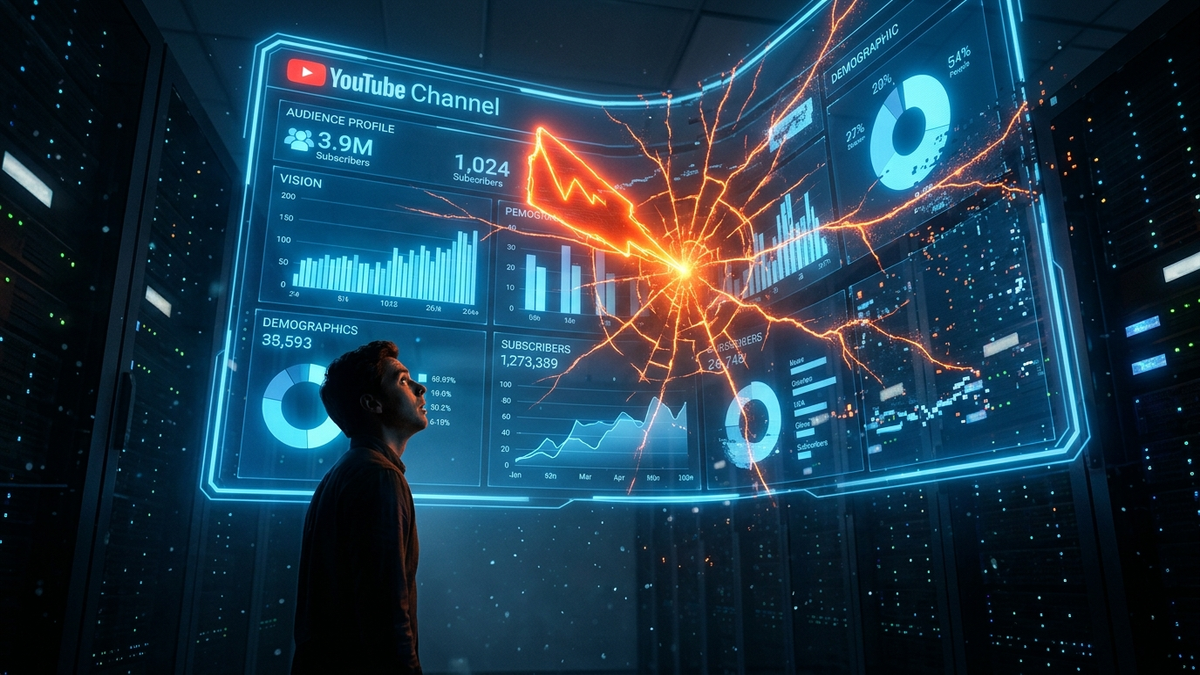
The "Viral" Trap: Why One Big Video Can Ruin Your Channel's Algorithm
Quick Answer (TL;DR)
- A viral video attracts a mismatched audience that is only interested in that one specific topic, not your channel's actual niche.
- This new, larger audience ignores your subsequent videos, causing your Click-Through Rate (CTR) and Average View Duration (AVD) to plummet.
- The algorithm interprets these poor metrics as your new content being "bad," so it stops promoting your channel, even to your original, loyal followers.
Introduction: The Dream That Becomes a Data Nightmare
Every creator dreams of it. You check your analytics, and one video is going parabolic. The views are piling up faster than you can refresh the page. You've gone viral. This is the moment you've been working for, the validation that you've finally "made it." But as a sysadmin and security guy who has spent 15 years watching systems break in unexpected ways, I'm here to tell you that this dream can quickly curdle into a nightmare. That one viral video, the one you think is your golden ticket, can become the digital tombstone for your channel.
This isn't a theory; it's a technical reality based on how recommendation algorithms actually work. They aren't your fans, they aren't your friends, and they certainly don't care about your creative vision. They are brutally efficient, pattern-matching engines designed for one purpose: to keep eyeballs glued to the platform. When you accidentally feed this machine a massive, anomalous data set—your viral video's audience—it can misinterpret everything you do next, leading to a slow and frustrating channel death spiral. Forget the celebration; let's pop the hood and diagnose the system failure before it happens to you.
Section 1: The Algorithm is a Pattern-Matching Machine, Not Your Friend
First, you need to get one thing straight in your head. The YouTube (or TikTok, or Instagram) algorithm is not a magical being trying to help you succeed. It's a cold, hard system of logic. Think of it like a network traffic analyzer in a corporate IT environment. My job isn't to guess what users *want* to do; my job is to analyze data packets and enforce rules based on established patterns. If a user's computer suddenly starts sending weird data packets to a server in China, I don't assume they have a new interest in international business. I assume it's a virus, and I quarantine it. The algorithm does the same, but with your audience's behavior.
Its primary directive is to maximize watch time across the entire platform. It achieves this by building a highly specific profile of your channel and its audience. It looks at who watches your videos, how long they watch (Average View Duration - AVD), what other videos they watch, and whether they click when your video is presented to them (Click-Through Rate - CTR). Over time, it builds a "perfect viewer" profile for your content. If you run a channel about restoring old fountain pens, the algorithm learns to show your videos to middle-aged men who also watch videos about calligraphy and woodworking. This is your "core audience profile."
When you upload a new video, the algorithm's process is simple. It first serves the video to a small test group of your most engaged subscribers—the people who fit that profile perfectly. If they click and watch for a long time, the algorithm says, "Aha! This video is a good match for this profile." It then pushes it out to a wider circle of people who fit the same profile. If that group also responds well, it pushes it out even further. This is how a healthy channel grows. The key here is pattern consistency. You are feeding the machine a consistent stream of data about who likes your very specific content, and it gets better and better at finding more of those people. It's a predictable, controllable system. The trap is sprung when you break that pattern in a massive, uncontrolled way.
Section 2: The Viral Event: A Flood of the "Wrong" People
Let's stick with our fountain pen channel. You've been steadily growing, getting a few thousand views per video from your dedicated audience. Then one day, you post a one-off video titled, "Watch Me Accidentally Stab Myself with a 1920s Parker Duofold." For whatever reason—the schadenfreude, the shock value—it goes nuclear. It gets picked up by the algorithm's "general interest" discovery engine and is shown to millions of people who have never even thought about a fountain pen. They're just there for the fail video. You get 5 million views and gain 50,000 new subscribers in a week. Champagne time, right? Wrong. You've just DDoS'd your own channel profile.
You haven't gained 50,000 new fans. You've gained 50,000 data points of pure noise. These people subscribed for the cheap thrill of the accident video. They don't care about the subtle art of nib grinding or the history of Italian celluloid. They are, from the algorithm's perspective, the "wrong" audience. Your carefully curated profile of "people who like vintage writing instruments" has just been flooded and overwritten by a new, much larger profile: "people who watch short, shocking fail videos." The algorithm, being a dumb machine, doesn't know the context. It just sees the new, overwhelming data set and assumes *this* is your new identity.
This is the critical failure point. The system has re-cataloged your channel. It's like if a quiet, respectable bookstore suddenly had a rave in it. The next day, the store's reputation isn't about classic literature anymore; it's about loud music and neon lights. The old, loyal customers are confused, and a new, temporary crowd is looking for something the store doesn't actually offer. You're getting all this attention, but it's for something you are not, and it's about to cause a catastrophic system conflict when you try to go back to business as usual.
Section 3: The Hangover: How the Algorithm Misinterprets Your New Videos
The celebration is over. You're buzzing from the viral hit, and now it's time to get back to your regular programming. You spend a week lovingly crafting a detailed video, "A Deep Dive into the Pelikan M800 Piston Mechanism." You upload it, expecting your new, massive audience to drive unprecedented views. And then... crickets. The video flatlines, getting even fewer views than your videos did *before* you went viral. You are now in the hangover phase, and it's brutal. Here's what's happening inside the machine.
The algorithm, now working with its new, polluted audience profile, takes your Pelikan M800 video and serves it to a test group of your new subscribers—the 50,000 people who came from the "stabbing" video. They see the title and thumbnail in their feed, right next to a MrBeast video and a compilation of cats falling off furniture. They don't click. Why would they? Your CTR plummets to less than 1%. For the few who do click out of curiosity, they're met with a slow, methodical explanation of a piston filler. They're gone in 15 seconds. Your Average View Duration tanks.
The algorithm sees these catastrophic signals and draws a simple, logical, and utterly wrong conclusion: "This video is terrible. Nobody who follows this channel wants to watch it." It's doing its job based on the data you gave it. The overwhelming negative signals from the new, mismatched audience tell the machine to stop pushing the video. The fatal blow is that it not only stops showing it to the new audience, but it also drastically reduces its promotion to your *original, loyal, fountain-pen-loving audience*. The system has flagged your new content as a dud, so it quarantines it, starving it of the reach it needs to find the very people it was made for. You've become a victim of your own success.
Turn your scripts into professional videos automatically. Use code PAVEL20 for 20% OFF!
START CREATING WITH PICTORY💡 Expert IT Tip: Use the "Audience" tab in YouTube Studio like a system log. Go to a new video that's underperforming and look at the "Subscribers" bell notifications data and the "Returning viewers" chart. If you see a massive number of subscribers but a tiny fraction of them are returning viewers for the new video, you've confirmed an audience mismatch. Cross-reference this with the viral video's analytics. Look at its "Audience" tab and see "Other videos your audience watched." If that list looks nothing like your niche, you have definitive proof your data set has been polluted.
Section 4: The Downward Spiral: Starving Your True Audience
This is where things get really grim. The initial failure of one or two videos post-viral-hit is just the beginning. The real damage is the long-term feedback loop it creates, a downward spiral that can be incredibly difficult to pull out of. Think of it as a DNS poisoning attack on your channel. A malicious actor (in this case, your viral video) has fed the system bad information, and now all requests (your new videos) are being routed to the wrong place, leading to a "service unavailable" error for your true fans.
Here's how the loop works: Your new video underperforms because it was served to the wrong audience. Because it underperformed, the algorithm "demotes" your channel's priority score. For your next upload, it will be even more cautious, showing it to an even smaller test group. This smaller group is still made up of your polluted subscriber base, so it also underperforms. This reinforces the algorithm's decision that your channel is now low-quality. This cycle repeats, with each video getting less and less initial reach. Your channel is now in algorithmic jail.
The worst part is the effect on your core audience. Your true fans, the ones who genuinely love your fountain pen content, are now seeing your videos less and less. The algorithm, convinced your content is failing, stops placing it high in their subscription feeds or suggesting it on their homepages. From their perspective, it might look like you've stopped uploading as frequently or that your quality has dropped (a perception bias, since they aren't even being given a chance to see it). They start to disengage, your loyal viewer base shrinks, and your subscriber churn rate increases. You are now losing the very people you built the channel for in the first place, all because you had one lucky hit with the wrong crowd.
Section 5: The Recovery Protocol: How to Fix a "Polluted" Algorithm
So, you're in the trap. Your numbers are in the toilet, and you feel like you've been punished for success. Can you fix it? Yes, but it requires the discipline of a system administrator restoring a server from a backup, not the frantic energy of a creator trying to catch lightning in a bottle twice. You have to systematically retrain the algorithm and prove to it who your real audience is. Forget about the viral numbers; they are ghost data. Your new goal is to re-establish your original, clean data pattern.
First, you must aggressively double-down on your core niche. No more one-off, populist videos. If your channel is about fountain pens, the next 10 to 20 videos must be the most hardcore, undiluted fountain pen content you can possibly create. You are sending a clear, repetitive signal to the algorithm: "The viral video was the anomaly. *This* is my channel's identity." Consistency is your most powerful tool. You need to create a new, strong pattern of viewership data that eventually outweighs the old, noisy data from the viral spike.
Second, focus entirely on metrics from your true audience. You need to create titles, thumbnails, and opening hooks designed to be irresistible *to them*, and nobody else. You want to maximize CTR and AVD from this core group. Ask for engagement in your videos. Tell your viewers that if they enjoy the content, liking and commenting sends a huge signal to the platform. You're essentially asking your loyal users to help you fight the algorithm's misunderstanding. It will be a slow grind. Your overall view counts will be low, but the *per-viewer engagement metrics* from the right people will start to improve. The algorithm will eventually notice that while the videos aren't getting millions of views, the small audience that *does* see them is watching for a very long time. This is the key to retraining it. It will slowly start rebuilding your old audience profile, and your reach will begin to recover.
💡 Expert IT Tip: Use a tool like TubeBuddy or VidIQ for "search-and-rescue" missions. Their keyword research tools are invaluable here. Instead of targeting broad, high-volume keywords that might attract a general audience, use these tools to find hyper-specific, long-tail keywords that *only* a true fan of your niche would search for. For our example, instead of "Best Pens," target "How to smooth a scratchy Pelikan gold nib." Winning the top spot on these low-competition, high-intent searches is a direct way to feed the algorithm with high-quality data from your core audience, accelerating the recovery process.
Conclusion: Build a Community, Not a Viral Moment
The allure of going viral is powerful, but it's the digital equivalent of junk food. It's a satisfying rush that provides no long-term sustenance and can make your system sick. As an IT professional, I've learned that stability, predictability, and consistent performance are infinitely more valuable than a single, chaotic spike in traffic that brings the whole network down. Your channel is that network. A viral video is a DDoS attack of irrelevant users that corrupts your routing tables.
Your goal should not be to have one video seen by a million people who don't care about you. Your goal should be to build a channel that is seen by a thousand true fans who will watch and engage with everything you create. That is a stable, healthy, and defensible system. Focus on serving your niche with unwavering consistency. Let the algorithm learn exactly who you are and what you do. Slow, steady, predictable growth is always superior to a lucky, chaotic explosion. Don't chase the flash flood; build the deep well.
Don't wait for the headlines. Our Private Telegram Channel delivers real-time AI security updates and digital wealth strategies before they go viral. Stay protected. Stay ahead.
⚡ JOIN THE 1% NOW🧰 Try Our Free Tools & Calculators
No sign-up required. Instantly check risks, analyze AI text, or calculate your digital finances.