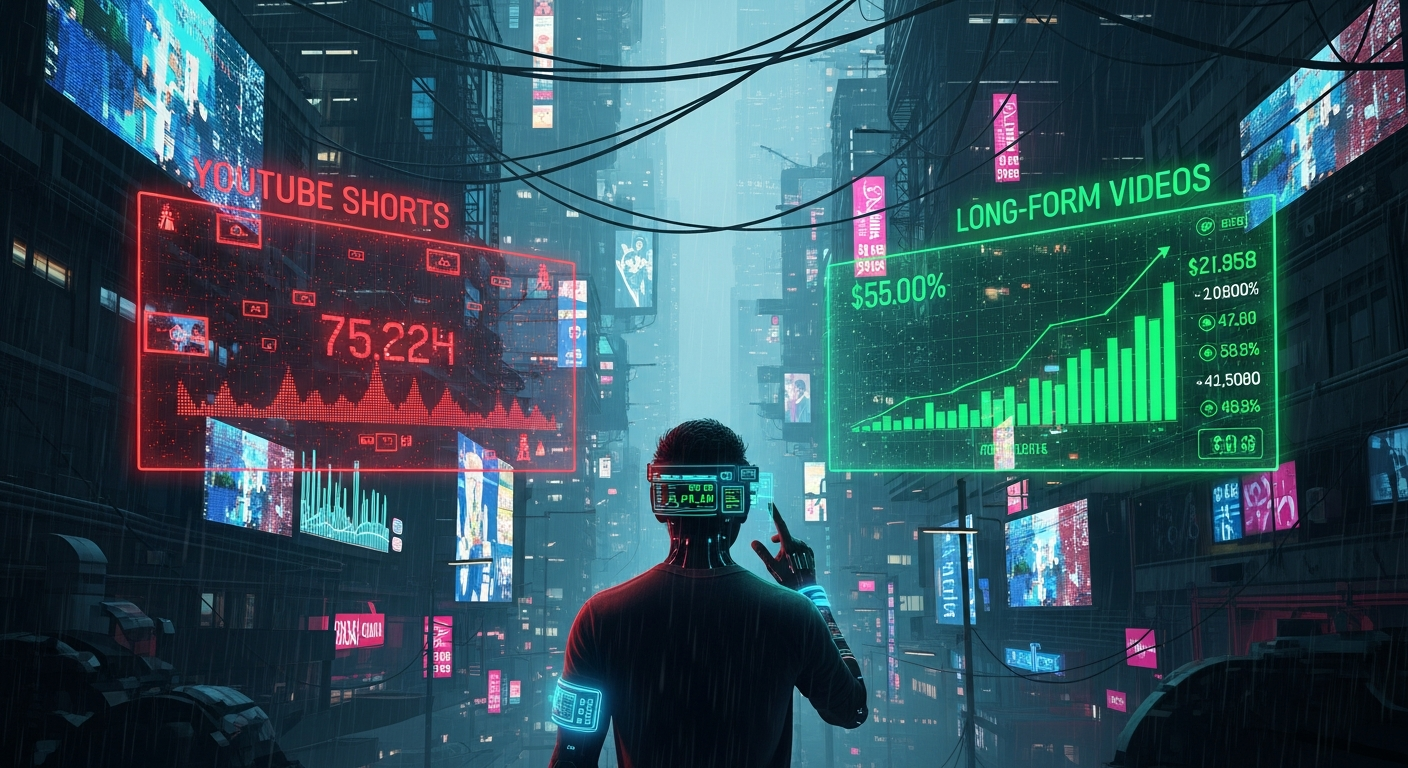
Decoding the YouTube Shorts CPM Mystery: Why Your Viral Shorts Earn Pennies on the Dollar
Quick Answer (TL;DR)
- Ad Format & Value: YouTube Shorts use a feed of low-cost, skippable vertical ads, whereas long-form videos feature high-value, targeted ad formats like pre-roll and mid-roll ads that command higher advertiser bids.
- Revenue Sharing Model: Long-form videos operate on a direct 55% revenue share for the creator. Shorts revenue is first pooled into a central Creator Pool, has music licensing costs deducted, and is then distributed based on view share, with creators receiving only 45% of their allocated portion.
- Advertiser Demand: Brands currently pay a premium for the engaged, high-intent audience of long-form content for direct-response marketing. The Shorts feed is often treated as a cheaper, lower-intent platform for brand awareness campaigns, resulting in lower CPMs.
- Viewer Behavior: Shorts are consumed in a rapid, "swipe-and-go" discovery mode, leading to lower ad engagement. Long-form viewers are in a more committed, "lean-back" viewing session, making them more receptive and valuable to advertisers.
Introduction
You’ve done it. You captured lightning in a bottle. Your YouTube Short, a masterpiece of concise editing and trending audio, has exploded. The view counter is spinning like a slot machine, hitting one million, then five, then ten million views. You're swimming in a sea of likes, comments, and new subscribers. The notification rush is intoxicating. Then, you open your YouTube Studio revenue tab, and the euphoria comes to a screeching halt. The payout for your viral sensation is... disappointing. In fact, it's a pittance, an amount so low it feels like a typo. You look over at your trusty long-form video from last month, a well-researched piece with a mere 50,000 views, and realize it has earned ten, twenty, or even fifty times more. This jarring financial reality check is a rite of passage for nearly every creator on the platform, leading to the crucial question: Why is my YouTube Shorts CPM so devastatingly low compared to my long-form videos? This isn't a simple anomaly; it's the result of a fundamental difference in the mechanics, economics, and psychology of two very different content ecosystems living under the same YouTube roof. This article will dissect the intricate machinery behind the great CPM divide, exploring everything from ad formats and revenue pools to advertiser intent and content strategy, so you can finally understand where the money is—and isn't—on YouTube.
The Fundamental Divide: Ad Formats and Viewer Intent
At the heart of the CPM chasm lies a stark difference in how advertising is delivered and consumed. The two formats, long-form and Shorts, represent entirely different psychological contracts with the viewer, and advertisers price their bids accordingly. Think of long-form video as a sit-down restaurant experience. The viewer has browsed a menu (their subscription feed or search results), made a deliberate choice, and is settling in for a specific meal (your 15-minute video). In this environment, YouTube can serve a variety of high-value ad types. The most lucrative of these are pre-roll and mid-roll ads. A pre-roll ad is the appetizer the restaurant serves before your main course; you expect it, and you're willing to sit through a skippable or even a non-skippable version because you are invested in the content that follows. Mid-roll ads, which creators can place in videos over eight minutes long, are even more valuable. They are akin to a sommelier visiting your table mid-meal; they capture the viewer when they are most engaged and engrossed. Because the audience is captive and has demonstrated clear intent by clicking on a specific video topic, advertisers can target them with surgical precision. A person watching a video on "How to Build a Gaming PC" is a prime target for ads from Intel, Nvidia, or Corsair. This contextual relevance allows advertisers to bid aggressively, knowing their ad spend is highly efficient, which directly inflates the CPM for that video.
Now, contrast this with the YouTube Shorts experience. If long-form is a restaurant, the Shorts feed is a sprawling, chaotic food festival with endless free samples. The viewer is not committed to any single creator or piece of content. They are in a state of rapid, dopamine-fueled discovery, swiping vertically through an infinite buffet of 60-second clips. Their thumb is perpetually poised for the next swipe. The advertising model here has to adapt to this fleeting attention span. Ads in the Shorts feed are not attached to a specific video but are instead injected between Shorts. They are just another piece of vertical content in the stream. This format fundamentally devalues the ad impression for several reasons. Firstly, the viewer is in a "swipe-and-go" mindset, not a "sit-and-watch" one. They are conditioned to flick away anything that doesn't provide an instant hook, including ads. Secondly, the contextual targeting that makes long-form so valuable is almost entirely lost. An ad for a financial planning service might appear sandwiched between a cat video and a dance challenge, a jarring juxtaposition that reduces its effectiveness. Advertisers understand this. They see the Shorts feed less as a place for targeted, high-intent conversion and more as a digital billboard for mass brand awareness. The goal is broad reach at a low cost, which naturally leads to much lower bids and, consequently, a rock-bottom CPM for the entire system.
- Long-Form Viewer Intent: High. The viewer has actively chosen the content, is mentally prepared for a longer session, and is more tolerant of integrated advertising as a trade-off for the value provided.
- Shorts Viewer Intent: Low. The viewer is passively consuming a feed, seeking quick entertainment hits, and is highly intolerant of interruptions, making them less receptive to advertising messages.
- Long-Form Ad Integration: Seamlessly integrated before or during a specific piece of chosen content, benefiting from the video's context and the viewer's engagement.
- Shorts Ad Integration: Disruptive insertion into a fast-paced, context-agnostic content stream, where it competes directly with entertainment for a split-second of attention.
This psychological and structural difference is the bedrock of the CPM disparity. Advertisers are willing to pay a premium to be part of an intentional viewing experience, while they pay bargain-basement prices for a fleeting impression in a high-volume, low-engagement feed. Until this fundamental dynamic changes, the CPM for Shorts will always trail far behind its long-form counterpart.
Deconstructing the Money Trail: The Creator Pool vs. Direct Revenue Sharing
Beyond the user experience, the single most significant reason for the low Shorts CPM lies in the complex and often misunderstood way YouTube calculates and distributes the revenue. The two systems are worlds apart. The traditional long-form monetization model, which has been the foundation of the YouTube Partner Program (YPP) for years, is a model of beautiful simplicity and transparency. Here's how it works: an advertiser pays YouTube to run an ad on your specific video. YouTube then takes a 45% platform fee, and you, the creator, receive the remaining 55%. The link between the ad revenue generated by your video and your payout is direct and linear. If an advertiser pays a high CPM to run ads on your content because your audience is highly valuable (e.g., viewers interested in finance or real estate), you directly benefit from that high CPM. Your earnings are a direct consequence of your content's ability to attract valuable ad placements. It's a meritocratic system where you are essentially a business partner, earning a direct commission on the sales you generate on your digital real estate.
The YouTube Shorts monetization model, introduced in February 2023, is a stark departure from this clarity. It operates on a convoluted, multi-step, pooled revenue system that systematically dilutes the value of any individual view. Let's break it down. Step 1: The Ad Revenue Pool. All the money generated from ads shown in the Shorts feed across the entire platform in a specific country is collected into one giant bucket. This money is not associated with any single creator's video. Step 2: The Music Licensing Deduction. Before creators get a whiff of this money, YouTube takes a significant chunk off the top to pay for music licensing. If you use one track from their commercial music library, this deduction is applied to your potential earnings. If you use two tracks, the deduction is even larger. This means a massive portion of the total ad revenue is immediately siphoned off to the music industry, a cost that doesn't exist in the same way for most long-form creators who use royalty-free music. Step 3: The Creator Pool Allocation. The money remaining after the music deduction forms the "Creator Pool." This pool is then allocated to monetizing creators based on their share of the total number of Shorts views in their country. So, if your Shorts accounted for 0.01% of all monetized Shorts views in the U.S. this month, you are allocated 0.01% of the U.S. Creator Pool. Step 4: The Final Payout. From your tiny allocated slice of the pie, YouTube then applies its revenue share. For Shorts, the split is inverted compared to long-form: YouTube takes 55%, and you, the creator, receive only 45%.
Turn your scripts into professional videos automatically. Use code PAVEL20 for 20% OFF!
START CREATING WITH PICTORYThe implications of this pooled model are profound. Firstly, your earnings are not tied to the value of the ads shown next to your content, but to your raw view count relative to everyone else. A view on a Short about advanced physics is worth the exact same as a view on a low-effort meme repost within this system. Secondly, your earnings are dependent on the total number of creators and views in the pool. If the number of monetized Shorts views on the platform doubles but the ad revenue in the pool only increases by 20%, every creator's RPM (Revenue Per Mille, or earnings per 1000 views) will plummet. You are competing with every other monetizing creator for a finite pot of money. This explains why a million views on a Short might earn you just a few dollars. Your million views are just a tiny drop in an ocean of trillions of global Shorts views, all vying for a piece of a revenue pool that has already been diminished by hefty music licensing fees. It transforms monetization from a direct partnership into a complex lottery where the house (and the music industry) takes its cut before you even see the cards.
The Advertiser's Perspective: Valuing Eyeballs and Bidding Wars
To truly grasp the CPM gap, one must step into the shoes of the people funding the entire ecosystem: the advertisers. For a brand's marketing department, every dollar spent must be justified with a measurable return on investment (ROI). When they allocate their budget to YouTube, they see two very distinct products—long-form placements and Shorts placements—and they value them very differently. Long-form video is a mature, premium advertising product. An advertiser buying ad space on a long-form video is purchasing access to a highly qualified and engaged audience. The platform's targeting capabilities are immense. They can target based on demographics, interests, keywords, and, most powerfully, the specific content of the video itself. This is called contextual targeting. A company like Squarespace can place its ads on videos about "starting a small business" or "building a portfolio website." A tool company can target DIY home renovation channels. This precision ensures minimal ad spend wastage and a higher likelihood of conversion. The viewer is in a "lean-back" mode, actively learning or being entertained, making them more receptive to a well-crafted ad message that aligns with their interests. Consequently, a bidding war ensues for these premium ad slots on high-value channels, driving the CPM sky-high for creators in lucrative niches like finance, technology, and business.
In contrast, the Shorts feed presents a far murkier value proposition for advertisers. It is largely a direct-response marketing desert and a brand-awareness playground. The primary goal for many brands advertising on Shorts is not to generate an immediate click or sale, but simply to get their name and logo in front of as many eyeballs as possible for the lowest possible cost. This is the realm of brand awareness campaigns, which inherently command lower CPMs than conversion-focused campaigns. The reasons for this are multi-faceted. As mentioned, the contextual targeting is weak; the algorithm has little to go on besides broad user data, as the ad is not tied to a specific video's content. The creative format is also a challenge. Crafting a compelling vertical video ad that can stop a "scrolling thumb" in under two seconds requires a different skill set and creative approach, which many brands are still learning. Furthermore, attribution—the process of proving that an ad led to a sale—is notoriously difficult in the Shorts feed. A user is unlikely to interrupt their rapid-fire viewing session to click an ad, navigate to a website, and make a purchase. They are more likely to see the ad, remember the brand name, and perhaps search for it later. This makes proving the ROI of a Shorts ad campaign a fuzzy science compared to the clean, trackable data from a long-form ad click.
- Long-Form Ad Value: High-intent, contextually targeted, conversion-focused, proven ROI. This leads to high advertiser confidence and aggressive bidding.
- Shorts Ad Value: Low-intent, context-agnostic, brand awareness-focused, difficult attribution. This leads to cautious advertiser spending and bids focused on cheap mass reach.
Therefore, advertisers approach their budgets logically. They allocate their high-cost, high-ROI budget to long-form pre-rolls and mid-rolls to capture qualified leads and drive sales. They then allocate their lower-cost, experimental, or mass-market budget to platforms like the Shorts feed, TikTok, and Instagram Reels to achieve broad visibility. The market has priced these two types of "eyeballs" differently, and as long as long-form videos are the superior tool for generating direct sales, they will continue to command a significant CPM premium.
The Content Ecosystem: Production Value, Virality, and Creator Sustainability
The economic models of Shorts and long-form content also reflect the vastly different levels of investment and sustainability associated with creating each type of video. Long-form content is, by its nature, an investment-heavy endeavor. A well-produced 20-minute video essay, documentary, or tutorial can require days or even weeks of work. This includes research, scripting, filming with quality equipment, extensive editing... and implement these strategies to ensure long-term success.
Conclusion
In summary, staying ahead of these trends is the key to business longevity and security. By following this guide, you maximize your growth and ensure a stable digital future.
Don't wait for the headlines. Our Private Telegram Channel delivers real-time AI security updates and digital wealth strategies before they go viral. Stay protected. Stay ahead.
⚡ JOIN THE 1% NOW🧰 Try Our Free Tools & Calculators
No sign-up required. Instantly check risks, analyze AI text, or calculate your digital finances.