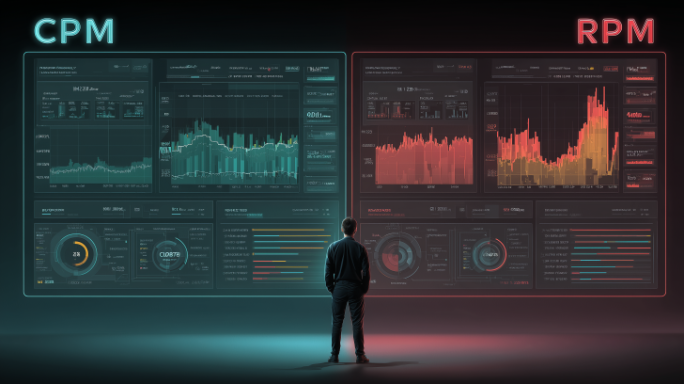
What is CPM on YouTube?
CPM stands for cost per mille – what advertisers pay YouTube for one thousand ad impressions. It’s mostly a metric from the advertiser’s perspective, not the creator’s.
What is RPM on YouTube?
RPM means revenue per mille – how much money you, the creator, actually earn per thousand video views. It already accounts for:
- YouTube’s revenue share.
- How many of your viewers saw ads at all.
- All monetized playbacks across formats (pre-roll, mid-roll, etc.).
Simple rule: CPM = what advertisers pay.
RPM = what you realistically earn per 1,000 views.
Why big CPM doesn’t always mean big payouts
High CPM can still lead to modest income if:
- Many viewers use ad blockers.
- Viewers skip ads quickly.
- Your audience comes from countries with lower ad rates.
- Your videos get clicks but very little watch time.
How to use RPM for planning your income
Once you have a rough RPM estimate, you can model realistic income targets. For example, if your RPM is around $5:
- 100,000 views ≈ $500
- 250,000 views ≈ $1,250
- 1,000,000 views ≈ $5,000
(These are purely illustrative, not guaranteed.)
Use a calculator to play with scenarios
Instead of doing the math by hand, plug your numbers into our YouTube money calculator:
- Enter your estimated RPM (or test a range: low, medium, high).
- Enter your expected number of views.
- See how much ad revenue that might translate into.
Bottom line: CPM is interesting for bragging rights, but RPM is what pays your rent.
When in doubt, optimise for better RPM and long-term audience trust, not just flashy stats.