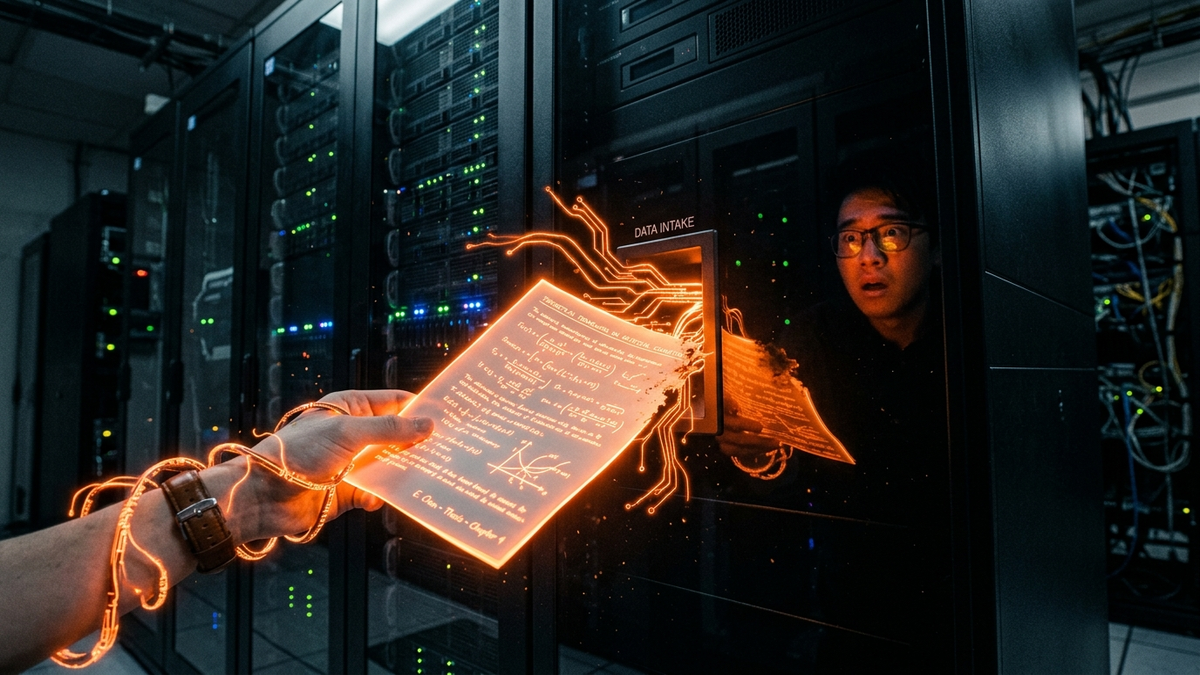
Free AI Checkers: Your Academic Savior or a Data-Stealing Scam?
Quick Answer (TL;DR)
- They are NOT reliable. Free AI checkers produce a high rate of "false positives" (flagging human work as AI) and "false negatives" (missing actual AI work), making them glorified guessing machines.
- Most are a PRIVACY nightmare. When you upload your paper to a free service, you are often giving them a license to use your intellectual property to train their own models or even sell your data.
- Your BEST defense is your workflow. The only guaranteed way to defend against an AI accusation is to have proof of your writing process, such as multiple drafts, outlines, and research notes.
Introduction
Let's cut the crap. You're here because you're worried. You've heard the horror stories of students getting flagged for using AI, even when they wrote every single word themselves. So you run your paper through a free online "AI detector" to see if you're safe, and the result either gives you a false sense of security or a full-blown panic attack. As someone who has spent 15 years locking down systems and sniffing out digital snake oil, I'm here to give you the brutally honest truth about these tools.
Think of this guide as a system administrator's debriefing. I'm not going to give you academic theory; I'm going to pop the hood on these checkers, show you the leaky engine and faulty wiring, and explain why trusting them with your academic career is like using a free, ad-supported parachute. We'll cover how they work, why they fail, the data-hungry business model behind them, and most importantly, how to actually protect yourself.
How These "AI Detectors" Actually Work (It's Not Magic)
First, you need to understand that these tools aren't performing some deep forensic analysis. They are not "detecting" AI in the way a metal detector finds a coin. Instead, they are playing a statistical guessing game based on how Large Language Models (LLMs) like ChatGPT are trained to write. The core of their operation boils down to two main concepts: "perplexity" and "burstiness."
Perplexity is basically a measure of how predictable your text is. AI models are trained to choose the most statistically probable next word, over and over again. This makes their writing incredibly smooth but also very predictable, resulting in low perplexity. Human writing is messier; we use weird phrases, slightly clunky sentences, and less common words, which gives our writing higher perplexity. The detector is essentially asking, "How surprised would a language model be by this sequence of words?" If the answer is "not surprised at all," it flags it as potential AI.
Burstiness refers to the rhythm and variation in sentence length. Humans tend to write in bursts—a few short sentences followed by a long, complex one, and then back again. It creates a natural, uneven rhythm. AI, especially older or less sophisticated models, often generates text with very uniform sentence lengths, creating a monotonous, robotic flow. The detector measures this variation, and if your text is too consistent, it raises a red flag. It's like listening to a perfectly timed metronome versus a human drummer; you can feel the difference.
So, when you paste your text into a checker, it's not looking for a "digital watermark" or some secret AI code. It's just running a statistical analysis on your word choices and sentence structure and comparing them to patterns it associates with machine-generated text. It's a probability score, not a verdict. This is a critical distinction that most users, and even some educators, completely miss. The tool is just a glorified pattern-matcher, and patterns can be deceiving.
The "False Positive" Nightmare: Why They Flag Human Writing
Now that you know these tools are just looking for predictable patterns, it should be obvious why they fail so spectacularly. They are shockingly bad at understanding context and intent, leading to a flood of "false positives" that cause innocent students immense stress. Your own, hard-earned words can be misidentified as machine-generated for a dozen different reasons, none of which involve cheating.
Are you a non-native English speaker? You've likely been taught to use very structured, grammatically correct sentences and a more limited vocabulary to ensure clarity. To an AI detector, this careful construction looks exactly like the low-perplexity, predictable text that an AI would generate. You are being punished for writing clearly and correctly according to the rules you were taught. It's a fundamentally biased system that favors the chaotic writing style of a native speaker.
The same goes for technical or scientific writing. If you're writing a lab report, a legal analysis, or a paper explaining a complex concept, you *have* to use precise, defined terminology and simple, declarative sentences. Clarity and accuracy are paramount. This writing style, by its very nature, has low perplexity and low burstiness. The AI detector sees this and screams "Robot!" because it can't tell the difference between a well-defined academic argument and a generic AI summary.
Even just following the instructions of a very specific prompt can get you flagged. If your professor asks you to "Define X, explain Y, and compare Z," you're going to structure your paper in a very logical, predictable way. This adherence to a rigid structure can be misinterpreted as the output of a machine that was given the exact same prompt. The tool has no idea about your assignment's constraints; it only sees the final, structured text and makes its guess. The system is fundamentally flawed because it assumes that all human writing is creative and messy, which is simply not true in an academic context.
💡 Expert IT Tip: If you're ever accused based on a detector's report, immediately ask for the specific tool used and its stated margin of error. Many of these tools (even the paid ones) have disclaimers buried in their terms of service admitting their own unreliability. Pointing out that the "evidence" comes from a tool that doesn't even trust itself can be a powerful part of your defense.
The Privacy Scam: What Happens to Your Paper After You Hit "Submit"?
Here’s where my cybersecurity alarms start blaring. When a service is offered for free online, you have to ask yourself one question: how are they making money? With free AI checkers, the answer is almost always: YOU are the product. Your data, your intellectual property, and your writing are the currency you're paying with, whether you realize it or not.
Think about it. You are handing over your original, often unpublished, work on a specific academic topic. When you click "submit," that text is sent to their servers. Read the fine print in their Terms of Service (which nobody ever does), and you'll often find clauses granting them a broad, non-exclusive, perpetual license to use, reproduce, and modify your submitted content. You are literally giving them your work for free, and they can do almost anything they want with it.
What do they do with it? First, they use it to train their own AI models. Your unique, human-written paper is an incredibly valuable piece of data for them. It helps them refine their detection algorithms and can even be used to build their own language models, which they can then commercialize. You are providing free labor and intellectual property to a for-profit company under the guise of "checking your work." It's a brilliant, and deeply exploitative, business model.
Second, your data can be aggregated and sold. They might not sell your specific paper with your name on it, but they can analyze thousands of papers on, say, macroeconomic trends, and sell those insights to hedge funds or marketing firms. They know what thousands of university students are researching in real-time. That's powerful market intelligence. They also collect metadata: your IP address, browser information, and potentially your email if you have to sign up. This profile of you can be sold to data brokers. A free AI checker is a data vacuum cleaner disguised as a helpful utility.
💡 Expert IT Tip: If you absolutely must use one of these tools, treat it like a hostile environment. Use a VPN to mask your IP address. Use a disposable, temporary email address from a service like Temp-Mail.org. Never use your real name or your university email. And for the love of god, before you upload the final version, consider changing key phrases or slightly scrambling some sentences so the version they get isn't identical to the one you submit.
Humanize your text and bypass any AI detector instantly with Undetectable AI.
BYPASS AI DETECTION NOWAre Paid Checkers (Like Turnitin's) Any Better?
This is the million-dollar question. Your university likely pays a hefty subscription for a service like Turnitin, which now includes an AI detection feature. The assumption is that because it's a paid, professional product, it must be accurate. The truth is more complicated. Yes, they are generally *better* than the free online junk, but they are far from infallible and operate on the same fundamental principles.
Turnitin's primary advantage isn't necessarily a superior AI detection algorithm; it's their colossal database. For decades, they have been collecting nearly every paper submitted by students at participating institutions. Their real strength is in traditional plagiarism detection—comparing your paper against a massive library of other papers. Their AI detector is a newer addition, and while it's backed by more resources and data than a free tool, it's still a statistical model. It's a bigger, more expensive hammer, but it's still just a hammer.
The problem is that these tools are often treated as a "black box" by institutions. A professor gets a report that says "85% AI-generated," and they may not have the training or technical background to question it. They trust the tool implicitly because the university paid for it. This creates a dangerous situation where a probabilistic score is treated as hard evidence. OpenAI, the creator of ChatGPT, has publicly stated that AI detection is unreliable and even shut down their own AI classifier tool because of its low accuracy rate. If the company that built the AI can't reliably detect it, why should we expect a third-party tool to do better?
Furthermore, these paid services are still data-hoarding operations. Your paper becomes a permanent part of their database, used to strengthen their product and business moat. While their privacy policies are typically more robust than the free-for-all scam sites, you are still feeding the machine. The core transaction is the same: you provide your intellectual property in exchange for a service. The difference is that your university is paying for the privilege of handing over its students' work.
The Real-World Consequences: What Your University Actually Does
Let's get down to brass tacks. A scary-looking AI score doesn't automatically equal expulsion. Any university with a shred of integrity uses an AI checker score as a starting point for a conversation, not as a final verdict. The tool's job is to flag potential issues for a human to review. The final decision rests with your professor and the academic integrity office, and you have a role to play in that process.
If you get called into a meeting about an AI flag, the first rule is: do not panic. Panicking makes you look guilty. You need to approach this like a system administrator troubleshooting a bug report. You are there to provide data and demonstrate your process. The burden of proof is ultimately on the university to prove you cheated, not on you to prove you are innocent, though being prepared makes their job much harder.
Here's your action plan. First, calmly and respectfully ask to see the report. What tool was used? What was the exact score? Which specific passages were flagged? Often, the flagged sections are things like your bibliography, common definitions, or direct quotes—all of which can look predictable to an algorithm. Second, you need to show your work. This is your silver bullet. Open your laptop and show them your Google Docs or Word version history. Show them the multiple drafts, the embarrassing typos, the sentences you rewrote ten times. Show them your outlines, your research notes, your browser history with links to your sources. No AI generates a paper that way. It doesn't have a messy, human process of creation. This documentation is your irrefutable proof of authorship.
The conversation should be about your intellectual journey. Explain *why* you made certain arguments. Talk about the sources you found and how they shaped your thinking. Discuss the feedback you got on a draft from the writing center. This narrative of creation is something a student who just copied and pasted from an AI cannot provide. The AI score becomes secondary when faced with overwhelming evidence of a legitimate, human-driven writing process.
The Only Foolproof Strategy: How to Write "AI-Proof" Papers
You can't control the flaws in AI detectors, and you can't control how your professor might interpret a report. The only thing you can fully control is your own writing and documentation process. Instead of worrying about how to "beat" the detectors, you should focus on creating work that is so demonstrably your own that any AI-based accusation would look ridiculous.
First, inject your own unique voice and experience. Use the word "I." Connect the topic, even if it's technical, to a personal anecdote, a class discussion, or something you read outside the required materials. For example, instead of just defining a concept, you could write, "When we discussed this in last Tuesday's lecture, I was struck by how..." This kind of specific, personal framing is very difficult for a generic AI to replicate and immediately adds a layer of authenticity.
Second, document your workflow like an IT admin documents a server change. This is non-negotiable. Always write your papers in a cloud-based service like Google Docs or Office 365 that has a detailed, automatic version history. Save your research notes, your brainstorming mind maps, and your outlines. Keep a simple log of your sources. This "digital paper trail" is your absolute best defense. If questioned, you can literally replay the creation of your document from a blank page to the final draft.
Here are some more concrete steps to make your work undeniably human:
- Cite unique sources: Go beyond the first page of Google. Reference specific points from a class lecture, a niche academic journal, or a physical book from the library. AI tends to pull from the most commonly available online sources.
- Embrace complexity: Don't be afraid to use a mix of long, complex sentences and short, punchy ones. This natural variation in rhythm (the "burstiness" we talked about) is a hallmark of human writing.
- Review and edit heavily: Your first draft might be simple, but the editing process is where your unique voice emerges. The record of these edits in your version history is powerful evidence of your engagement with the text.
Ultimately, the goal isn't to trick a stupid algorithm. It's to produce good, honest, and defensible academic work. If you focus on a transparent and well-documented process, you'll never have to sweat a false positive again.
Conclusion
So, are free AI checkers reliable? Absolutely not. They are poorly designed statistical tools that are, at best, a novelty and, at worst, a privacy-invading scam that can cause you serious, unwarranted trouble. They prey on student anxiety, offering a simple solution to a complex problem while harvesting your intellectual property in the background.
Relying on them is a fool's errand. The real solution isn't technological; it's procedural. The ultimate defense against a false accusation of AI use is not a "clean" score from some random website, but a rich, documented history of your own hard work. Keep your drafts, save your notes, and be prepared to walk your professor through your creative process.
Stop outsourcing your peace of mind to a flawed algorithm. Trust your own brain, trust your own process, and build a workflow that makes your authorship undeniable. That's how you win this game, not by trying to outsmart the machine, but by proving you're human.
Don't wait for the headlines. Our Private Telegram Channel delivers real-time AI security updates and digital wealth strategies before they go viral. Stay protected. Stay ahead.
⚡ JOIN THE 1% NOW🧰 Try Our Free Tools & Calculators
No sign-up required. Instantly check risks, analyze AI text, or calculate your digital finances.