Bluetooth Vulnerabilities 2026: Why You Should Turn It Off in Public
Quick Answer (TL;DR)
- Leaving Bluetooth on in public broadcasts a unique ID, making you a target for data theft, tracking, and no-click exploits that can take over your device without you even touching it.
- Hackers use cheap, easily available tools to perform "Man-in-the-Middle" attacks at places like airports and coffee shops, intercepting data between your phone and your headphones or car.
- The only guaranteed way to protect yourself from these invisible, radio-based threats in a public space is to turn Bluetooth completely off when you are not actively and safely using it.
Introduction: That Convenient Blue Light is a Huge Red Flag
Listen up. We all love the convenience. Wireless headphones, smartwatches, connecting to your car stereo in a split second—it feels like magic. But I've spent 15 years in the trenches of IT security, and I'm here to tell you that this magic has a dark side. That little blue icon in your phone's status bar is not just a symbol of convenience; in a public space, it's a vulnerability, a digital "kick me" sign taped to your back.
For years, the advice was simple: "Don't pair with devices you don't recognize." That's kindergarten-level security now. The game has changed completely. Attackers don't need you to click, accept, or pair with anything anymore. They can exploit the very radio waves your phone is broadcasting just by being on.
This isn't some far-off, futuristic threat. The tools are cheap, the techniques are all over the internet, and the targets are people like you, sitting in a coffee shop, waiting for a flight, or walking through a mall. By 2026, as more of our critical devices—from medical implants to car keys—rely on this technology, the stakes will be higher than ever. It's time for some brutal honesty about the risk you're taking every time you leave that blue light on.
Section 1: The Invisible Net: How Bluetooth Actually Works and Why It's a Hacker's Playground
Let's get one thing straight. Bluetooth isn't just a simple link between your phone and your headphones. It's a complex radio communication protocol, and like any protocol, it has rules. Hackers are experts at bending and breaking those rules. Think of your phone's Bluetooth as a small, personal radio station that's constantly broadcasting, "Hey, I'm here! My name is [Your Device's Name], and my unique address is [Your Bluetooth MAC Address]. Who wants to talk?"
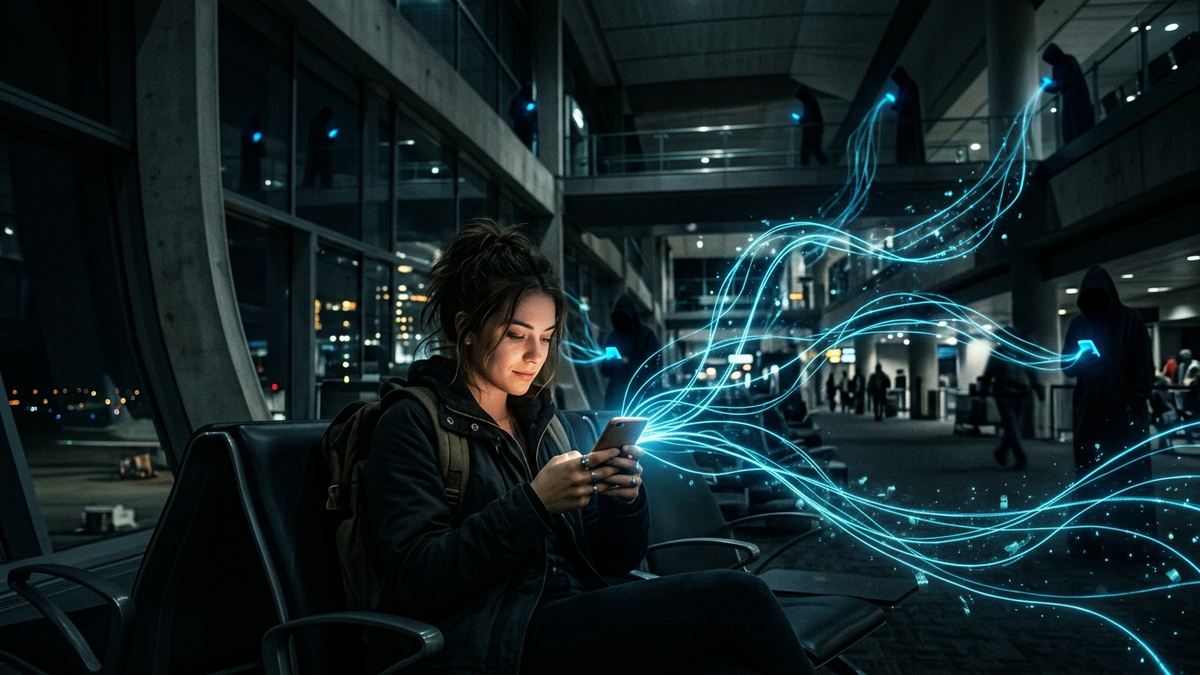
This "shouting into the void" is the first problem. It makes your device discoverable. Even if you set it to be "non-discoverable," it often still sends out signals that can be picked up by anyone with the right (and surprisingly cheap) equipment. These signals are the threads of an invisible net cast across every public space. Every active Bluetooth device is a potential catch for an attacker scanning the airwaves.
There are two main flavors of Bluetooth you're using: Classic and Bluetooth Low Energy (BLE). Classic is for high-data things like streaming audio to your headphones. BLE is for short, bursty communication, like a smartwatch syncing notifications or a fitness tracker updating its status. Both have their own sets of vulnerabilities. BLE, in particular, is designed for constant, low-power broadcasting, which makes it a fantastic tool for tracking. Retail stores use BLE beacons to see how you move through their aisles. By leaving yours on, you're volunteering for that surveillance and telling every data broker in the vicinity exactly where you are and for how long.
The core issue is the "attack surface." Every active service on your phone—Wi-Fi, NFC, and especially Bluetooth—is a potential door into your digital life. Bluetooth is particularly dangerous because it's designed to accept unsolicited connections from new devices. That's its entire purpose. But that openness is what attackers exploit. They don't see a convenient way to pair a keyboard; they see an unlocked door waiting for someone to jiggle the handle.
Section 2: The "No-Click" Nightmare: Exploits That Own Your Device Without You Doing a Thing
This is the part that should really worry you. In the old days, a hacker had to trick you. They'd send you a weird file (BlueJacking) or try to pair with you to steal your contacts (BlueSnarfing). That required you to make a mistake. Today's most dangerous attacks require zero interaction from you. Your phone can be sitting on the table, locked, and you can still get hacked if Bluetooth is on.
Let's talk about a real-world family of vulnerabilities called BlueBorne. This was a wake-up call for the entire industry. BlueBorne allowed an attacker to scan for nearby active Bluetooth devices and, by sending a specially crafted packet, could trigger a memory corruption bug. The end result? Complete remote code execution. In plain English, a hacker could take total control of your phone—read your messages, steal your files, turn on your camera—all without you ever getting a notification or a pairing request. You wouldn't know until it was too late. While patched in modern operating systems, the core principle—exploiting the Bluetooth stack itself—is alive and well.
Then you have things like the KNOB (Key Negotiation of Bluetooth) Attack. This is a clever one. It interferes with the "handshake" process when two devices are pairing. It forces them to agree on an incredibly weak encryption key—sometimes just a single character. Think of it like two spies agreeing on a secret code, but a third person yells, "Just use the letter 'A' for everything!" Now, the attacker can easily crack that "encryption" and listen in on everything being transmitted between your devices.
Looking ahead to 2026, we're seeing more vulnerabilities like BrakTooth. This isn't one bug, but a collection of over a dozen flaws found in the Bluetooth chips themselves—the hardware from major manufacturers that's inside billions of devices. These flaws can cause everything from a simple device crash (a denial-of-service attack) to, once again, letting an attacker run their own code on your device. The problem is that patching a hardware flaw is much harder than patching software. Many devices, especially cheaper headphones or accessories, will never get an update, remaining permanently vulnerable.
💡 Expert IT Tip: Don't just trust, verify. Install an advanced Bluetooth scanner app on your phone, like 'nRF Connect for Mobile' by Nordic Semiconductor (available on both iOS and Android). It's a powerful tool that shows you *everything* that's broadcasting around you—every beacon, every headphone, every hidden device. You'll be shocked at the sheer volume of signals in a public place. It helps you visualize the invisible net you're walking through and can help you identify suspicious devices trying to mimic your own.
Section 3: Location Tracking and Digital Stalking: You're Broadcasting Your Every Move
The threat isn't just about someone hacking your phone's data; it's also about them hacking your life's data—your physical movements. Your device's Bluetooth signature is a unique identifier, like a digital license plate. As you move through a city, your phone is constantly responding to scans from retail beacons, advertising trackers, and other surveillance systems.
Secure your digital wealth with the world's most trusted hardware wallets.
GET YOUR WALLET NOWHere's how it works: A coffee shop, a mall, or even a bus stop has a small, hidden Bluetooth beacon. This beacon's only job is to scan for and log the unique MAC address of any device that passes by with Bluetooth enabled. Over time, different data brokers who own these scanners can piece together your daily routine. They know what time you get your morning coffee, which route you take to work, how long you spend at the gym, and where you shop. This data is aggregated, anonymized (in theory), and sold to advertisers. It's a massive, unregulated industry built on the fact that most people leave their Bluetooth on 24/7.
But it gets much darker than targeted ads. The proliferation of cheap tracking tags, like Apple's AirTags or Tiles, has created a new toolkit for stalkers and criminals. These devices work by using the Bluetooth signal of *any* nearby phone—not just the owner's—to report their location back to the network. If a stalker slips a tracker into your bag, your own phone's active Bluetooth signal could be helping them track you. Even if you don't own a tracker, your phone becomes an unwilling accomplice in a massive, crowdsourced surveillance network.
Criminals are also using this to their advantage. They can sit in a parking lot with a Bluetooth scanner to identify which cars have expensive audio systems or which ones might have a phone or laptop left inside. They can even perform "wardriving" for Bluetooth, mapping out devices in a residential area to identify potential targets for burglary. You think your phone is just sitting there idly, but it's actively telling the world, "Here I am, a valuable piece of electronics, currently located at these exact GPS coordinates."
Section 4: The Airport & Coffee Shop Scam: The "Man-in-the-Middle" Attack
The "Man-in-the-Middle" (MitM) attack is one of the oldest tricks in the book, but it's found a terrifying new life with Bluetooth. This is where an attacker secretly intercepts and potentially alters the communication between two parties who believe they are communicating directly with each other. A busy, noisy airport terminal or a crowded coffee shop is the perfect hunting ground for this.
Imagine this scenario: You sit down and take out your brand-new wireless earbuds. You open the case to pair them with your phone. At that exact moment, an attacker sitting a few tables away, using a laptop with a powerful antenna and specialized software, detects your pairing request. Their system immediately spoofs your earbuds' identity and broadcasts a stronger signal. Your phone, thinking it's found the right device, connects to the attacker's laptop instead of your earbuds.
Now what? The attacker's laptop is the "man in the middle." It connects to your actual earbuds, creating a bridge. To you, everything seems normal. Music plays, and calls work. But every single bit of data is now flowing through the attacker's machine first. They can record your phone calls. If you're using a Bluetooth keyboard to type a password, they can capture your keystrokes. They could even attempt to inject malicious data packets back to your phone, potentially exploiting other vulnerabilities to install malware.
This isn't science fiction, and it no longer requires a nation-state's budget. Tools like the Flipper Zero, a handheld "multi-tool for geeks," have made sniffing and spoofing Bluetooth signals more accessible than ever. An attacker can sit there, looking like they're just playing a game on a small device, while they are actively trying to hijack every Bluetooth connection around them. By leaving your Bluetooth on and discoverable, you're essentially raising your hand and volunteering to be the next victim.
💡 Expert IT Tip: Practice good "pairing hygiene." The most vulnerable moment is the very first time you pair a device. Always perform the initial pairing in a secure, private location like your home, not in a crowded public space. Furthermore, regularly audit your list of paired devices on your phone. If you see an old headset you sold, a rental car you drove six months ago, or anything you don't recognize, delete the pairing immediately. Each saved pairing is a trusted relationship that an attacker could potentially try to exploit.
Section 5: Your Step-by-Step Public Defense Protocol: How to Actually Stay Safe
Okay, I've thrown a lot of scary scenarios at you. Now let's talk about the practical, no-nonsense defense plan. This isn't about being paranoid; it's about being smart and disciplined. Security is a habit, not a product you can buy. Follow these steps, and you'll be safer than 99% of the people around you.
Here is your protocol. Memorize it. Practice it.
- 1. The Golden Rule: Off By Default. This is the most important rule. If you are in a public space—an airport, train, coffee shop, mall, or just walking down the street—and you are not *actively* using a Bluetooth device, turn it off. Not just disconnected, but turned off from your Control Center or Quick Settings. It takes two seconds. Make it a reflex, just like locking your car door.
- 2. Disable Discoverability (When You Must Use It). If you absolutely must use Bluetooth in public (e.g., for your headphones on a plane), make sure your device is not in a "discoverable" or "pairing" mode. On most modern phones, they only become discoverable when you are actually in the Bluetooth settings menu. Avoid sitting in that menu in public. Once your trusted device is connected, no one else needs to be able to find you.
- 3. Audit Your Paired Devices Religiously. Once a month, open your Bluetooth settings and review your list of paired devices. See that "Ford Sync" from a rental car? Remove it. That "Friend's Speaker" from a party? Remove it. Every device on that list represents a stored "key" on your phone. If an attacker can spoof the identity of that old, forgotten device, your phone might automatically connect to them without asking. A shorter list means a smaller attack surface.
- 4. Update Everything, All The Time. I cannot stress this enough. Those annoying software update notifications on your phone, laptop, and even your smartwatch are not suggestions; they are critical security commands. Companies like Apple and Google are in a constant arms race with hackers. When a vulnerability like BlueBorne is discovered, they release a patch. If you don't apply it, you are willingly leaving a known, unlocked door on your device. This also includes the firmware for your accessories! Check your headphone or speaker's app for firmware updates regularly.
- 5. Reject All Unsolicited Requests. This should be obvious, but it happens. If you ever get a pop-up on your phone asking to pair with a device you don't recognize, the answer is always, always, NO. Deny it. Block it. Never accept a pairing request you did not personally initiate just seconds before. It's the digital equivalent of a stranger asking for the keys to your house.
Conclusion: Convenience Isn't Worth the Compromise
Look, I get it. Turning a feature on and off feels like a step backward. But in the current security climate, the trade-off between constant convenience and fundamental safety is no longer balanced. The risks are invisible, silent, and carry devastating potential consequences, from financial loss to severe privacy invasion. The technologies and techniques available to even low-skilled attackers are evolving far faster than the public's security awareness.
Leaving your Bluetooth active in public is like walking through a bad neighborhood yelling out your home address and the fact that you've left the front door unlocked. Maybe nothing will happen today. Maybe not tomorrow. But eventually, someone will take you up on the offer. You have a simple, powerful tool at your disposal to prevent this: the 'Off' button. Use it.
Don't wait for the headlines. Our Private Telegram Channel delivers real-time AI security updates and digital wealth strategies before they go viral. Stay protected. Stay ahead.
⚡ JOIN THE 1% NOW🧰 Try Our Free Tools & Calculators
No sign-up required. Instantly check risks, analyze AI text, or calculate your digital finances.